Countries

Showing posts with label Buenos Aires. Show all posts

Thursday, November 17, 2011

Tourists like lists (or so I hope)


I think it's time to give a shot at writing something more touristy, so here goes: a set of list and tips for anyone vacationing in the city.

The Fairs, ranked

1.     Ferria de Los Inmigrantes – this is not a regular fair, but if you’re around in September, it makes a great lunch spot.  You won’t get the South American feel, because countries like India, Germany, Russia, and more are represented in the booths, but this fair is one of the few not aimed at tourists. Whereas San Telmo is teeming with souveneirs, the main things to buy here are food, and hats, clothes, and trinkets from other countries. What makes this fair stand out is the dancing. A stage is set up in front of a perfect picnic spot, with dancing and singing throughout the day. Smaller dances seem to break out randomly among costumed members of other booths.
2.     Ferria de los Matadores: There’s dancing at this fair, too, though it’s less diverse. The dance is a folklore style, accompanied by music, and I heard rumor that sometimes the fair has horse tricks, though I was disappointed to find they weren’t happening the day I went. It seems to be luck of the draw what you’ll get to see. While this fair is also touristy, full of leather belts, wooden flutes, chocolate, cheap bread, and alcohol, the prices are excellent (a bottle of wine for 13 pesos, for instance).
3.     San Telmo fair: This fair happens every Sunday and is notable for its sheer size. The fair consumes several city blocks in many directions, and you can walk for hours still seeing new things. It is a very touristy fair, and there’s a pressure to shop for souvenirs the whole time. Here and there in the fair will be musicians playing guitar or even on a metal bowl, and mimes for children. Some cool highlights were boxes made out of a single orange peel, the ubiquitous soft wool sweaters with llama designs, and some delicious homemade pastries from a woman pushing a cart.
4.     Tigre’s Fruit Fair: this fair on the river offers good fruit smoothies, and a large collection of items ranging from earrings to furniture in the nearby shops. None of it’s items are truly unique, but you can get cheap yerba in bulk, and lots of fruit.
5.     Ferria Recoleta at Plaza Francia: This is another weekly fair, and a nice place to peruse on the way to the cemetery or one of the nearby art museums. All the products are touristy, meaning a quick way to pick up souvenirs, but a bit pricier just for that reason. You’ll find things like mate gourds, leather belts, and shirts.
6.     Gay Pride Parade: This gets listed last because it’s a special, one-day event. From buttons to alfajores, everything’s rainbow, and you’ll see some “intriguing” costumes.

If you’re interested in shopping, there are always the malls her (called “Shoppings” by the Argentines), but they’re likely to be pricey. They’re much more elegant and elaborate places than those of the U.S., and if you decide just to go to check it out, it may feel like you’re walking in a hotel.

Best Museums
1.     Evita Museo: If you love culture, this is for you.
2.     MALBA: a Latin American arts museum with a huge and diverse collection, ranging from traditional to abstract and modern.
3.     Museo Bellas Artes
4.     Recoleta Centro Cultural
5.     Trelew: Egidio Feruglio Museo: a small museum, good for an hour or so, but with impressively complete dinosaur skeletons.
6.     San Antonio de Areco: Gaucho Museo: Ok
7.     San Antonio de Areco: Cultural Museo: Don’t even bother, though it costs about one dollar and no guards will stop you from touching all the exhibits.

Transport
1. In the Hand: Buy yourself a Guía T and figure out how to use it. The bus stops are confusing, as the book will only tell you what street to look on, not what intersection, but it’s the best hardcopy map I’ve been able to find.

2. On the computer: To get a closer idea of where bus stops are, look at the routes and the bus suggetions online at http://mapa.buenosaires.gov.ar/

3. On the streets: The train (subte) runs quickly and until 10:30pm. After that, you’ve got to find a bus, or give in and take a taxi. Only take Radio Taxis, because sometimes you can end up with a bogus taxi who will rip you off, or worse.

Food
1.     Lentil stew: it’s delicious; a thick stew, often with chunks of potato and beef.
2.     Mandioca: this root actually comes from Paraguay, but is popular here, no doubt for it’s complex texture. “Chipas” are a dense, bagel-shaped food made from mandioca flour.
3.     Alfajores: you’re obliged to try some, and they won’t be hard to find, whether you grab a packaged one from a kiosko or buy a fancier version at a bakery, and they vary a lot. The best I’ve had are AlfajOreos (this doesn’t really count: it’s more like a tall Oreo sandwich in a chocolate shell), maicena alfajores (soft cookies, thick dulce de leche filling, and rolled in shredded coconut), and a Vaquía brand alfajore well filled with a liquid Cappuccino filling.
4.     Empanadas: as with alfajores, you haven’t been to Argentina if you haven’t tried one of these. They come in a huge variety, the most common being stuffed with ground beef or ham and cheese. I recommend corn or caprese-filled ones.

Bars:
I’m afraid I haven’t been to many, so this list will be short, sweet, and under-informed.

1. Acabar: board games, restaurant, and bar. What else could you want? Try the “Spare Time” drink: it’s neon blue and sweet. What else could you want?
2. El Alamo: my favorite straight-up bar, because the people are friendly and mix easily. You can get about 2 liters of beer for ridiculously cheap (I’d guess $5), if you’re into that sort of thing.

3. Jobs: another board game bar, far more elaborate than the other. There’s pool tables, darts, and, if you go on the right days (Saturday, Tuesday, Thursday), even archery. If you arrive before midnight you can skip the 30 peso cover charge and get a free pizza.

4.Shamrock: An Irish pub that varies a lot by the day; can be so crowded it’s a fight to get drinks, or can be a good time.

5.Le Bar: I can’t say much for the drinks, because I didn’t order one, but the ambience is nice. The seating is sunk into the floors, the lights are low, and you can go on the roof. The time I went there was a band, too.


Wednesday, November 16, 2011

I Don’t Remember How . . . But the Terrorists Are Dead

This entry is immensely long, and it's also about one of the top two most interesting things I've experienced in Argentina.

In Full View
Twice a week Tribunal Oral en lo Criminal Nº1, a courthouse in La Plata, Buenos Aires closes off the street in front of it, and holds a trial on the rights abuses during the late 70s. This period in Argentina, from 1976-1983, is often called the “Dirty War”, except for by its victims, who claim it was not a war, because a war needs two armies. Instead they use the term “el Proceso” (“the Process”) to refer to 7 years of a government preying on any citizen who spoke against it. While it is important to remember that the citizens’ opposition was not pacifistic, they did not deserve what happened.
            The trial my class and I went to see was for information, not for a verdict. The defendant on the stand Miguel Osvaldo Etchecolatz, the Director of Investigations for the Police of Buenos Aires during the Proceso, had already been condemned to life in jail in 2006. The trial was purely to find information, about a particular occurrence during those years.
            Anyone with identification can enter a courtroom and watch a trial, and my school group was joined by art students and some middle aged observers. One woman with long white hair was a founding member of the Mothers of the Plaza de Mayo, a group that still demands justice for the children the government secretly kidnapped during the Proceso. The only rules the courthouse gave us were you must be over fourteen, because the themes were so heavy, and you could not bring in food or water, lest you throw them at someone. This implied the due bitterness surrounding the trials. The courthouse staff gave us official wristbands and let us enter.

  
Set the Stage
The courtroom itself appeared to be an old theater. The seats the public sat in looked just like those for a play-going audience, and a red curtain was pulled to the side above the stage where sat the judge, defendant, and lawyers. Despite its theatrical origins, it was a very plain building, devoid of any decorations. A somber place dedicated to a practical job: finding the truth.
            The judge sat facing the audience, along with two assistants. (It surprised me to see that one had dyed her hair magenta). On the right, rows of prosecuting lawyers with laptops and coffee cups, faced inwards, towards center stage. On the left, a cage jutted out into the audience, and here, protected by five guards in bulletproof jackets reading “SPF”, sat the defense. One guard had a riot shield, and they spent the time watching the audience and the case. Throughout the trial more guards with radios and black berets walked the floor.
            Etchecolatz rose, a normal looking older man with white hair and a gray suit, and sat at a desk, his back to the audience, facing the judge. This is what evil looks like, I told myself, knowing I was seeing a man who had presided over murder and torture, and yet I felt no repulsion. This was just a man.


Clara Anahí as photographed by her grandmother days before the attack. I borrowed it from: http://www.apdhlaplata.org.ar/espacio/n31/esp12.htm

Memory of Family
Etchecolatz had been called in from prison to give his account on the case of Casa 30. This house had been home to five Montoneros, anti-government rebels, and two of theirs baby girl. Most importantly, the house hosted a secret printing press the Montoneros used to distribute their political flyers. To cover it up, they raised and sold rabbits (as food, not pets). Because of this, the novel written about Casa 30 is called “Casa de Los Conejos”, or “House of Rabbits”.

Etchecolatz and the police attacked the house in 1976, killing everyone inside it, save, perhaps, for the three month old baby, Clara Anahí Mariani. Neighbors reported seeing the police take the baby from the house, and it was not an uncommon practice for police to kidnap children and raise them as their own. Estimates say 400 of these “disappeared” children are going about their lives today, completely unaware of their real identities. Clara Anahí’s grandmother is still looking for her; if she has survived this long, she turned 35 last August. But even if Clara Anahí was taken alive from the house, she could have been hit by a car at age 15 and died, or died of cancer at age 30; if alive she might not even still be in the country. It soon became clear that Etchecolatz’s objective in the trial was to say the daughter was dead, and thus that the search should stop, and that he was not complicit in anything blameworthy. 


Designing Justice
Trials in Latin America follow a different structure from the U.S.’s precedent-based system. The codified system in Latin America places more trust in written evidence and reviewing data, while the USA emphasizes oral evidence from witnesses. Watching this case, another difference became obvious: in Argentina, the judge, in addition to the lawyers, has a chance to examine the defense, and the defense can be brought in to be questioned again, if new evidence appears. For an hour or more, our judge questioned Etchecolatz           

Summary: Ray of Truth, Fog of Lies
The events of the day at Casa 30 began to become clear as the trial proceeded. The facts that Etchecolatz and other accounts agreed upon were that Etchecolatz had arrived at Casa 30 along with other military officers, that several officers entered the house, and that the five Montoneros were killed. During the attack on Casa 30, Etchecolatz was on the roof of the adjacent house, along with a man with a bazooka.

Etchecolatz handwaved over his involvement, trying to suggest that his entire participation in the conflict had been to merely exist on the roof, instead of having any job assigned to him, or having been involved with organizing the event. The police director also attempted to put a nationalistic, positive spin on the actions of the police in the Proceso, presenting them as a civilian, humanitarian group, and putting all blame for torture on the military. Part of Etchecolatz’s aim was also to insist that the Proceso had not been unilateral aggression: “[Los Montoneros] también tenía resistencia”  (“The Montoneros also had resistance”) he said, and claimed the guerrillas had killed 270 policemen.
There were a few notable flaws with Etchecolatz’s account. First, he, the director of police, had followed someone else’s orders to go to the house, and yet had not been assigned any role to do while there. He hadn’t been on the roof to catch people fleeing, he insisted, nor even really to observe.  Secondly, all the Montoneros were to be killed and their bodies burned, Etchecolatz reported, yet he claims neither saw bodies nor flames nor heard shots. In regards to the detention centers, in Etchecolatz’s world, the police were merely there to take care of the abducted people’s health and nutrition, the rest was the military’s job. Finally, despite physical evidence and numerous first hand accounts, Etchecolatz denied that torture was a common occurrence.  

In Defense of a Nation
When Perón ran for president in 1945, it was immediately after World War II and photos of the concentration camps were just leaking out to full public view. The U.S. ambassador, Braden, accused Perón of supporting Hitler and harboring Nazis. To explain to the class why this was such a harsh, campaign-damaging accusation, my history teacher clarified: it would be like saying you supported the ESMA, a major detention center used in the Proceso. Argentina is a place where those responsible for the Proceso draw a quicker gut reaction, a more immediate repulsion, than Nazis. In my human rights classes and history classes, no one could even question that the military committed horrors.
Just thirty years after the Proceso, and in a society where everyone knows the full extent of the abuses committed, I heard Etchecolatz continue to assert that his actions were fully justified. While I had been warned that most of the Proceso’s human rights criminals were unrepentant, it still felt unreal. Etchecolatz referred to those kidnapped by the government as “terroristas” (terrorists), and “prisioneros de la guerra” (prisoners of war”).
“Tenían que perseguirlo [y] matarlos como ratas” (“We had to chase them [and] kill them like rats”), he insisted; The Proceso was a campaign to protect country’s institutions, and allow Argentina to live in peace. 

Words for War
Among Etchecolatz’s description of the military government, stark nationalistic phrases continued to pop up.  He told how the military government had tried to “recuperar la verdad” (“to recover the truth”), “recuperar lo que ha perdido” (“to recover what had been lost”), “[asegurar] respecta para sus instituciones” (“to ensure respect for its institutions”), “[asegurar que Argentina puede] vivir en paz” (“to makes sure that Argentina could live in peace”), “sofocar una situación de ofensa” (“to suffocate an offensive situation”), and “afrentar el enemigo” (“to confront the enemy”).

Brainwashed Language
During the Proceso itself, the government enacted a huge propaganda campaign in which they repeatedly used nationalistic images to present their work as glorious and righteous and encourage belief in their side. If the police and guerrillas clashed, the newspaper was bound to report that the police had eliminated a subversive, or, if luck went the other way, that a policeman had been murdered by terrorists.
Euphemisms made torture seem less offensive: a “sumbarino” (submarine) is a tasty treat similar to hot chocolate, made by dropping a bar of chocolate in warm milk. When the government attached the name “submarino” to a form of torture, it became easier for soldiers to distance themselves from what they were actually doing: waterboarding a victim in water tainted with feces and urine.  In a 1984-esque attempt to cut down on subversive thought, the word “revolution” was banned, even including in reference to science.

Play by Play


It feels the most honest representation is to report the event as straightforwardly as possible, including giving the original Spanish, as that is the most accurate and true wording. I will translate as closely as I can.

What Did You Do?
It began with the judge questioning:
“¿Cuándo se producen muertes era porque hay sido resistencias?”
When killing occurred was it because there had been resistance?

I didn’t catch all of Etchecolatz‘s response. It was something like:
 “Somos ciudadanos .. . . no es así permitir abusos, no recibí ningún orden de torturas. . .”
We are citizens . . .it is not so that abuses were allowed, I didn’t receive any order to torture. . .

In a somewhat jumbled way, Etchecolatz went on to detail the event. The government forces attacked Casa 30 because it had a printer for “panfletos terroristas” (“terrorist pamphlets”) in the house. He believed that everyone in Casa 30 was killed, as the order had been to leave no one alive (“nadie quedar con vida”). Officers entered that house, the Montoneros inside resisted (at least he emphasized that he thought this was what happened), and, presumably, said Etchecolatz, the officers killed them all. Still, he reminded his listeners “no vi nada” (“I didn’t see anything”), and “no oí disparos” (“I didn’t hear shots”). Etchecolatz said that  “fueran carbonizados a todos en la casa” (“Everyone in the house was burned to ashes”), but when the judge asked he admitted that he had not seen fire or felt heat. Witnesses in other meetings on this case had also not seen fire. According to my human rights teacher, it was a common practice for the military/police to take away the bodies of their victims, so as to leave no tangible evidence. If Etchecolatz could suggest the bodies were burned, he would not have to explain what actually happened to them. But he could not blatantly contradict the testimonies of other witnesses.

The judge picked at the story:
“¿Por qué estabas allá si hiciste nada? ¿Cómo fue estar en el techo sin ver nada? ¿Por qué estabas en el techo? Los disparos de afuera . . .estabas allá parar matar a alguien que saliera de la casa?”

Why were you there if you didn’t do anything? How was it that you were on the roof and saw nothing? Why were you on the roof? The shots outside . . .where you there to kill anyone who left the house?

Etchecolatz:
 “Estaba allá por parte de posición en la policía”
I was there as part of my position in the police.
He continued, saying that he was only support and that no one gave him an order.

Judge:
“¿Dices que no hecho ningún tipo de exceso? ¿Nunca influido por exceso del gobierno de este época?”
You said that you never committed any type of excess? You were never influenced by the excesses of the government of this time?

Etchecolatz:
“Lo que cumplí estaba acuerdo del ley”
What I did was in agreement with the law.

Judge:
 “Si recibió un orden a matar, debió negar”
If one received an order to kill, one should refuse it.

Etchecolatz:
“¡Ningún orden matar!”
There wasn’t any order to kill!

Etchecolatz continued, saying that he had only received orders to go to the roof. 


Vanished Children

Judge:
“¿Hijos de personas desaparecidos eran recobrados?”
Were the children of the disappeared recovered?

Etchecolatz:
“No sé.”
I don’t know.


In regards to the child Clara Anahí, Etchecolatz merely mentioned that the people in the house “enseñaba a niña revistas subversivos” (“taught the girl subversive magazines”); this is no doubt a major reason the military would have taken her. El Argentino, a newspaper present at the trial that day, quoted Etchecolatz as saying “No puedo asegurar que la criatura estaba adentro, pero si estaba adentro, la criatura no pudo salir con vida” (“I can’t be sure that the child was inside, but if she was inside, the child could not have left with her life”). Despite this claim, it is known, thanks to a testimony in El Argentino, that the police had at one point attempted to sell Clara Anahí to her grandmother, something that strongly suggests the child was not killed at the house. Relatively recently, it was thought that the daughter of the owner of Clarín, an important newspaper, was in fact Clara Anahí. The daughters looked similar, were of the right age, and it was known that the newspaper owner’s daughter was adopted under strange circumstances. For much time the newspaper owner’s lawyers stalled and resisted requests for a DNA test, then suddenly agreed to it, presumably because they discovered through other evidence that the daughter was not a match.


A Skeptical Audience
In response another line of questioning, Etchecolatz told the judge that whatever happened to pregnant women was the decision of the clandestine detention centers that held them, and was not his fault. The police, he said, were only responsible for the health and food of the prisoners, nothing else. The police’s orders, he reiterated, were to “mantener higiene, cuidar salud física, no interrogar” (“to maintain hygiene, to take care of physical health, not to interrogate”). The military was the one who had the responsibility for the prisoners and the detention centers.

However, Etchecolatz said he did remember one instance of a pregnant prisoner. When this girl gave birth, he said, the staff at the detention center bought her presents and a card. Groans of disbelief rose from the audience when they heard this. He couldn’t remember the girl’s name or last name. But she was from La Plata, the neighborhood the trial was in, he said, and the police, because it was a humanitarian issue, took charge of letting her family know.
By this point, the audience had seen thousands such trials, and knew to expect these sort of responses from the accused. In 1986 it was prohibited to try anyone for human rights abuses committed during the Proceso and since then many criminals were pardoned. About a decade ago, then-president Néstor Kirchner re-opened the trials. The lying and lack of repentance was nothing new to the audience of this trial, and the bitterness was clear. When Etchecolatz announced that “caminaba en lo más sucio de la sociedad y no me contaminaba” (I walked in the filthiest part of society, and it didn’t contaminate me”) members of the audience laughed aloud in scorn. 


Remember with Care
When the judge returned to asking Etchecolatz about the events on the day at Casa 30, Etchecolatz tried to say he didn’t remember much of anything. Occasionally, in the trial Etchecolatz  would get flustered responding to questions, would answer in a stream of “Sísísísísí” or “Nononono.” After prodding, he admitted he did remember how he arrived (in a car), but not who drove it, and admitted that he did now remember that others were in the car with him. He did not remember, however, who ordered the attack on the “casa de los terroristas” (“the terrorists’ house”).  As Etchecolatz was the director of the police, it is a fair bet that he himself ordered the attack.


Here the lawyers took over.
One asked:
¿Si no estaba parte de investigaciones, si solo cuidaba salud física, porque estaba a la Casa 30?”
If you weren’t there as part of the investigations, if you only took care of physical health, why were you at Casa 30?

I don’t believe Etchecolatz answered this one. 


The white building or this flat roof here is likely where Etchecolatz was during the attack.

House of Holes
After the trial, we went to see Casa 30, a small gray cement building. A whole window and most of the wall was blasted out, presumably by the bazooka, and deep holes marked around the door and wall. Glancing through a bullet hole on one wall we could see inside the house, a wall similarly pockmarked by bullets. The roof Etchecolatz must have stood on could not have been more than 8 feet from the door of Casa 30.


 The house itself has been preserved as it was since the attack


Epilogue: The Curtain Doesn’t Fall
The face and name Jorge Julio López is something I've seen graffitied all across Buenos Aires, on walls, on tiles in La Plaza de Mayo, and especially in La Plata. Eventually, I learned why.

in La Plata

at Plaza de Mayo


This man had been kidnapped and personally tortured by Etchecolatz from 1976-1979. During the first trial of Etchecolatz, López was a major witness, and his testimony against Etchecolatz was invaluable: In addition to recounting to his own horrific experience, López had seen Etchecolatz execute five people.
Though the Proceso trials offer a form of resolution and validation, testifying is nonetheless extremely painful for the victims. In a documentary on this trial, called “Un Claro Día de Justicia” (“A Clear Day of Justice”), I saw López struggling to get the words out. He remembered a woman named Patricia who was imprisoned with him; he was the only one of them with a chance of leaving the detention center alive, she told him, and she begged López to find her parents or her brothers and tell them to “dame un beso a mis hijas” (“give a kiss to my daughters for me”). Recounting, reliving, this moment, López’s voice almost failed him, it was with painful effort that he managed to speak. The older man’s hands trembled, like a hummingbird flapping, so much that he couldn’t pick up a glass of water; someone had to hold it out for him to sip. 

López during the trial. (Photo credit to Haydeé Dessal y Elena Luz González Bazán at http://www.villacrespomibarrio.com.ar/2011/septiembre/ciudad/derechos%20humanos/lopez%20en%20fotos.htm)

           During the days of this trial, López, a white haired, 77 year old man with children, vanished. In the midst of recounting his horrifying disappearance, disappearances ceased to be a memory and became the state of his life once again. (The trials continued without López, and Etchecolatz was sentenced to life in prison.) This was five years ago. López still has not been found.
            It was 23 years after the end of the Proceso, supposedly in a better government and better world, and yet, with López’s abduction, the disappearances were re-opened. Since then, there have been accusations the police’s fruitlessness in the case is deliberate. The satire magazine, Revista Barcelona, publishes a weekly piece ridiculing the police’s attempts to find López. Clara Anahí and Jorge Julio López have still not been found, but until they, or their final resting places are, the trials will still go on, and the protests will continue in the Plaza de Mayo.


                 Calendar titled "How many days without López?"; Displayed in ESMA, previous site of a navy clandestine detention center.


Links:
López’s testimony (in Spanish): http://www.youtube.com/watch?v=Ayyh_169cF8


Monday, November 14, 2011

Pretty Places: Tigre


About two months ago I took a weekend trip to an area called Tigre, with a group from my program. It’s a beautiful Argentine get-away on a muddy river (darkened by sediment, not pollution). The area seems mostly inhabited by vacationers and those who run businesses for vacationers, and is known for a fruit fair.

Right about now, in full summer, the area would be at it’s best, I think, because it will be warm enough to swim and the flowers will be more in bloom. As it was, it was a great place; we pedal boated and kayaked, walked around the woods, and played Scrabble in Spanish. 

Our program organized the hotel, and as we looked around at the 2 person luxury cabins in the woods we’d been assigned to, we realized we’d been placed into a honey moon suite. It even came with a sexy music CD and beds that slide together.

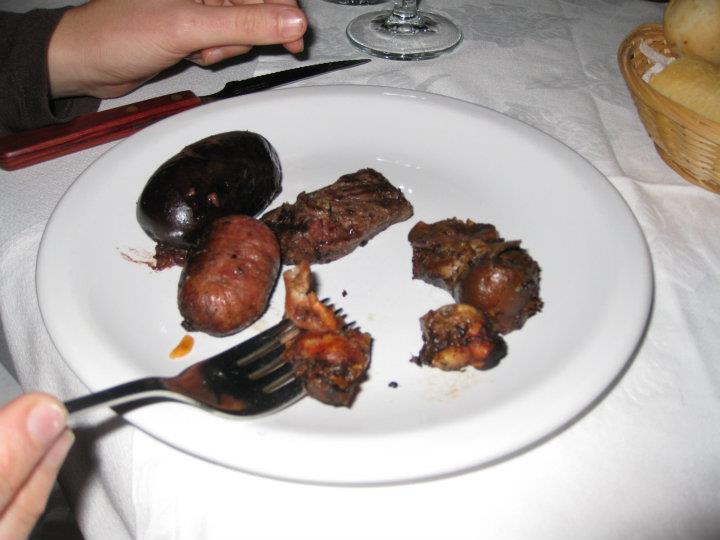
While made a few more small steps of food tasting in the name of one large step for foodiekind. Some of the more intriguing elements were cow kidneys, a new type of blood sausage, cow gullet, and cow intestine. The blood sausage was lumpier and less intense than what I’d been given at my first homestay; I rate this an improvement. I couldn’t finish the kidneys, thanks to their overpowering flavor. The intestine itself had no offensive taste, and was overcooked to be very chewy. Victory went to the gullet, which I really just remember as being kind of soft.

I also came to realize that in regards to alfajores, the maicena kind is where it’s at. These are more likely to have a thicker dulce de leche filling, instead of a token coating, and the dense cookies of these don’t taste artificial, unlike the average kiosko alfajore.


If I remember correctly, the dark one is blood sausage, and the kidney is speared on the fork. 

Sunday, November 6, 2011

Saint Land


“Tierra Santa”; Buenos Aire’s Jerusalem theme park. The park was not the tacky, touristy travesty that we had all hoped for, but still made a fun outing. The whole place was full of plastic Middle Eastern buildings and statues recreating scenes like Jesus expelling the money lenders. (There were even plastic palm trees next to the real palm trees, as if the parks’ designer didn’t realize that these things actually grow in Argentina). The tranquil music in the park actually set the stage well, and I was thrilled to see Roman guards wandering around, and people in Arabic style clothing sweeping. (Not to mention that it was awesome to finally be able to buy hummus and eggplant for lunch). I also desperately wanted to go on the merry-go-round (which featured donkeys, camels, and an angel on top), but, tragically for my merry-go-round fixation, it was closed. And only for children. We did go to see the several shows the park offers, including the Creation of the Universe, recreated through neon lights and moving robots of the first life. 


The crowning moment was the Resurrection show, when a gigantic, 20-foot tall Jesus rose from the top of a hill to the sound of “Hallelujahs”. 

GayZombieLaws

                                          Yum yum diversity.
Gay Pride

Yesterday, I went to a gay pride parade, which turned out not to be a parade, but a plaza full of stands selling rainbow colored goods. Given Argentina’s love affair with fairs, it was actually rather fitting. A few of the more interesting merchandise included rainbow colored alfajores and chocolate popsicles shaped like penises.  The event also attracted a few elaborate costumes, such as a woman dressed solely in one yellow thong and gold sparkle body paint, and a variety of drag queens.  (One man, dressed in a dominatrix costume, was immediately encircled by cameras. He kept having to turn and turn to face each new camera that surrounded him. I felt like I was watching  a captured animal, that instead of frightened, was sultry). 
Gay pride is different in Argentina, where although prejudice still exists, gay marriage is legal throughout the country. There was one stand protesting against the church and calling for a greater separation between church and state, which leads me to believe the marriage is still a big issue, just civil unions are legal. Still, the focus of this event was transgender people. They are not allowed to change their national IDs to state their preferred gender, which in many ways can make them easy targets (as any police can see, for example, that Laura looks feminine, but her ID still says “male”), and it can cause hassles. One of my friends’ professors at the UBA is transgender, and the bathrooms are swipe-to-enter. Though the professor looks male, he can only access the women’s bathroom, and the police have been called on him twice for being a man in a woman’s bathroom. (Why you would call the police about this is another question . .. .). Tuesday, the government votes to change this transgender-ID policy.

                                 The fair! I still find it odd to see alcohol sold at booths
Abortion
Another vote that recently failed by just 2 signatures was to legalize abortion. Right now, you can only have an abortion if you are both mentally disabled and raped. (It used to be either disabled OR raped, but in a rewriting of the constitution, someone changed it. Or thus says my history teacher).

Economy
In other legal news, a few days back Argentine prohibited it’s people from buying U.S. dollars. The peso’s value is based on the dollar, so many people, not trusting the Argentine economy, have been just buying dollars hoping they’re more secure and because they’re rising in value (much like we’d buy gold). It’s also important, because here you can only make major purchases in dollars (for instance, buying a house), and other countries won’t accept pesos, so if you travel to Uruguay, for example, you’ll need to change currency first.

I’m not quite sure why Cristina blocked purchases. According to an economist I met on the street, it costs a government a lot to keep buying foreign currency to supply to their citizens (likely that, just like banks mark up the price when they sell you currency, other countries do this too). Also, forcing people to use pesos means that money stays in Argentina and gets invested here, instead of sent out of the country. Still, the lack of being able to buy costly things is going to be a major problem.

School
Friday there were only about 7 students who came to the school I help out with. It turns out, the teachers in the village are on strike so the kids neither have classes or homework. Apparently this is common; the teachers are always negotiating better deals, and if they don’t like the compromises, they strike. I know in the U.S. some Sates legally prohibit teachers and other public employees (like postal workers and police) from striking.

Zombies
The lack of marching at the gay pride parade also reminds me of the lack of walking at the zombie walk last weekend. It seems Argentines are a sedentary people. The zombie “walk” was still an interesting event: a plaza full of costumes, and Argentine geek culture. Those who didn’t dress up often wore metal band T-shirts (Iron Maiden seems to be popular here), and I caught a glimpse to El Eternauta. I didn’t dress up, but I did dance Thriller.

Sunday, October 23, 2011

Muy Amable

A few weeks ago, I ran into a German woman at MALBA, a well-known Latin American art museum, and translated between her and the ticket seller. The German had only been in the city a few days; while Buenos Aires was nice, she complained that the people were all unfriendly.

It was raining when I left the museum, an hour or so later. A few minutes into my walk, a young woman (who turned out to work for a law firm) offered me a space under her umbrella, and we chatted. Barely 30 seconds after our paths diverged, another woman, probably 40 years old, shared her umbrella with me, happy to tell me about interesting cultural centers. She walked two blocks out of her way to bring me to the door of my university.

While it’s true that you can’t set your bag down in a restaurant for fear of it getting stolen, and that men will whistle at you on the street, especially if you have any bare leg showing, Argentina is an amazingly friendly country. Pull out a Guía T map book, and strangers will come up to you and offer directions to anywhere you want to go.

Yesterday, I tried to go to a community tango class. The teacher and us had a confusion over the every changing start time, and missed each other. Not wanting to go straight home after the hour bus ride here, a from my program and I and an Argentine who we just met, ended up hanging out. The Argentine, Fernando had planned to come to the class for the first time that day. Who knows what the he had planned for his day, but  he took the time to come have dinner with us for 2 hours, then invited us to a friend’s birthday party that night. I ended up going, and it was astounding how friendly the people were. It was a grand mix of 20-somethings, mostly law or political science grad students (everyone in Buenos Aires seems to be a lawyer), including among the Argentines an El Salvadorian, two Brazilians, a Venezuelan, and several people from the US, here teaching English. No one cared that I didn’t know the man who’s birthday it was, and everyone was eager to talk.  (I’ve been feeling more like a real Argentine now that I’m taking in a bit more of the night life, though tonight I went home at 3:30am. I think that’s about the earliest it’s acceptable to leave in Argentina, but still makes you a little lame).

Today, several friends and I went to a neighborhood called La Plata. It’s an hour away from Buenos Aires central, and is a nice little town, that sports some beautiful European architecture. There’s an impressively tall and elaborate church with gleaming stained glass and a nice crafts fair (every town seems to have one of the weekends). The city was one of the first planned out cities, and is structured around 2 major diagonals. We mostly wandered about, and found that every few blocks seemed to have a park complete with playgrounds. In our part of the city, all the playgrounds have fences around them, presumably to keep out homeless at night, and it was nice to find playgrounds that didn’t seem to judge you for entering.  On the way there, we met two men from La Plata. One seemed quite the hipster: skinny jeans, oversized bright blue sleeveless T-shirt, and a small mustache. He’d moved to Buenos Aires to escape the violent treatment he got in La Plata for dressing the way he did. Though Argentina is liberal enough law-wise to allow gay marriage throughout the country, the further you get away from the city, and it seems, the city center, the more conservative the people are. These men assured us that we could call them for anything we wanted (and they weren’t hitting on us, we had two guy friends in our group), and that it was important for them that we feel at home in Argentina. 

Flash History Lesson: ESMA

Friday I went to ESMA, a startlingly beautiful complex of buildings, full of green, graceful trees and the smell of lavender. The place itself was home to a large Navy school, and a center where kidnapped civilians were routinely tortured and imprisoned before being thrown into the ocean to drown.

Argentinean had essentially it’s mini version of the Holocaust, in which the national government turned on its own citizens.

The short version of events:
1. Juan Domingo Perón, beloved by the left and the right, returns to Argentina from exile.
2. Fighting breaks out between the left and right Peronists, resulting in combat between terrorism by leftists Peronists, and equivalent violence by the Peronists government, who sides with the right.
3. Perón dies shortly after, leaving his third wife in office. While Perón’s second wife, Evita, had left behind women’s suffrage, workers rights programs and the like as her mark, Isabel leaves behind an government run death-squad, the Triple A.
4. To everyone’s relief, the military overthrows Isabel Perón.
5. Promising to return stability, the military government begins pursuing leftists. And people who know leftists. And people who generally walked on the same street a leftist walked on. This quote in a newspaper pretty much sums it up:
“First we will kill all the subversives, then we will kill their collaborators, then their sympathizers, then those who remain indifferent and finally we will kill those who are undecided.” – General Ibério Saint-Jean (March 20, 1977)

The junta also make sure to remind the public that it was the citizens who voted for Perón, and thus the Triple A is the public’s fault. Like a parent taking away a child’s toy because it’s dangerous, the junta condescendilyg reminded Argentineans that they weren’t responsible enough to have a democracy yet.

5. A decade of secret abductions begins, in which plain clothes policemen break into people’s houses at night, kidnap them, rob their houses, and occasionally take the children for their own. The desaparecidos or “disappeared” are held and tortured in secret detention centers around the city, while the government completely denies knowledge. Children born in the centers are adopted by military personnel and raised with false identities. When the military decides it’s done with a  desaparecido, he or she is drugged, loaded into a plain, and thrown alive into the ocean to die. Usually his or her stomach is cut open to facilitate it being eaten by fish.

6. There’s a fantastic slew of propaganda insisting that the desaparecidos are merely run-aways, who abducted themselves, and that countries calling for an end to this military regime are really anti-Argentinean and completely ignorant about Argentinean life.

7. Due to economic problems, mismanagement, the government’s not doing so well. They decide to war with Britain for the disputed Malvinas/Falklands Islands, which causes the nationalistic fervor the government had hoped for. Until Margaret Thatcher resoundingly defeats Argentina, and the public add the soldier’s deaths to the blood on the government’s hands.

8. Declaring their mission, their “Dirty War” a victory, the junta government shuts down.
Later, when the government attempts to try the torturers, the military, appalled, marvels that Argentina is the only country that would try it’s “victorious heroes”.

The scariest part:
These events still haven’t been resolved.
Democracy returned in 1983, and the president, Alfonsín, began to try the military perpetrators. The military grumblings got loud enough that the president feared the democracy was at risk of being overthrown again if he didn’t quit it. So he pardoned everyone who could claim to be “just following orders” (that has a Holocaust ring to it, no?) and promises to end trials by 1987.  And that was it for a while; the military went free to wander in the same society, go shopping in the same supermarkets, as their victims. Only the cases of kidnapped children could still be tried, as those were counted as on going crimes, because the kids were still living with false identities.

Carlos Menem became president next, and, presumably thinking this would let  Argentina move on, pardoned everyone. Spain and England were rightly horrified, and, calling the military’s actions “human right’s abuse”, insisted they would try anyone they could catch. So the military perpetrators hid in Argentina, from which the president declines to extradite them.

Néstor Krichner became president and re-opened trials. The only reason the military didn’t freak out this time is that being tried by their home country beats being tried by Spain. They trials are still going on. According to our guide at ESMA, who himself had been imprisoned there for 2 years, 100 kids have recovered their identities, and 400 are still living, unwittingly, with the people who murdered their biological parents. A few months ago, a witness in a desaparecido trial testified about being tortured and kept in one of the detention centers. During the weeks of the trial, he was disappeared again. He still hasn’t been found.

New and Interesting Info:
Desaparecidos at ESMA were forced to work falsifying documents, something I hadn’t heard about before. In general, they made fake passports and visas for members of the military, so the members could go abroad (including to the US) and use information they found in other countries to help them spy on their own people. Argentina, who at the time was in conflict with Chile, also made counterfeit Chilean currency to drop into the country and damage its economy. (Always an interesting military tactic. I hear the Union did this to the Confederacy during the US’s civil war. The Union’s counterfeits were so much better quality, that no one would accept legitimate Confederacy bills, thinking they were fakes). Our guide told us that anyone sent to work counterfeiting currency knew it as a death sentence. The operation was so secret, they would never be allowed to live. 

ESMA is a chilling place, whose museum includes photos of the murdered, and photos of the military abductors. They offer a guided tour of the detention center, two cultural arts centers, and a fantastically cheap café.  

Sunday, September 25, 2011

Petty Crime

 I had my first brush with petty crime last Monday, at a vegetarian takeout place (actually great way to save money and stave off scurvy at the same time!). The way the system works is you take a plastic carton, put what food you want in it, and then bring it to the cashiers. One cashier weighs the food, and tells you the price, and then puts your dish on the counter, in front of a second cashier, who takes your money.
            In Argentina, the shop owners either don’t have change, or try at all costs to not to use theirs up. An exaggeration, of course, but it’s not that uncommon for people to say they can’t break 2 pesos (50 cents, American). Thus was my case. The man demanded exact change, down to the cents. I had to hunt through my money purse for coins, as people continued to slide their dishes on the counter next to mine and buy food. As I routed around for the last 10 cents, having already handed over the rest of the cash, I felt a brush of air, which I assumed was just another person taking their food. When I looked up, several moments later, my lunch was gone.           
            At first, I was merely confused, thinking that the cashier had been guarding my food until I paid him for it. He announced he didn’t have it, and rapidly lost interest, as I had already paid. The other cashier asked what was wrong.
 I told them, “I paid but I don’t know where my lunch is.” The other guy kind of nodded and decided it wasn’t his business.
But I continued bothering the first guy, “I gave you money, and now I don’t have anything.”
I wasn’t quite sure who had been robbed as the food was stolen while I was still paying. Both of us, I guess. (An odd note about this, was that the person could have easily filled a dish and walked out the door, they didn’t need to wait in line to steal anything).
“You should protect your stuff,” the cashier told me, and went on to ignore me and check out other customers. I was rather annoyed. Being an American, I was raised to think that if the customers not always right, they at least deserve some respect. I was annoyed at him for insisting he wouldn’t accept my money unless I could find exact coinage and at him for not paying attention while I was distracted by paying him in the manner he insisted. In the U.S., the restaurant staff would have been apologetic over this situation, they would have offered me a new lunch, or a discount, I assume, but mostly, in the U.S. this wouldn’t have happened. I was annoyed at the cashiers for being part of a country where people didn’t even have the respect to wait until after I’d paid to rob me (and be clear that it was me he/she was robbing). Argentina is a country where strangers will stop to offer you directions without even being asked. It’s also a country where people will seize any opportunity. In the end, I announced to the cashiers that I had paid them for food, and so was going to take food, and I went and got a new plate, and left. Maybe I was a thief now, too?

History note, courtesy of my Service Learning class: since the latest financial crisis, Argentina has become known for petty theft. Violence is rare, but stealing is high. There’s not a lot of job stability, and so the poorer classes tend to move from one type of temporary work to another, and mix in petty crime. Jobs aren’t vocations or identities: no one has a job long enough to associate with it. Instead, it’s just another way of getting money, not different from crime other than having fixed hours. It’s common for people to hold a salaried job to pay for general expenses, and a side “job” of theft, to pay for fun.
That’s not to say everyone does this, but it’s been a noted trend, say the sociologists. I saw a documentary on a group of people called “carteneros” (there’s no exact translation, the best I’d say is “cardboard people”). These incredibly poor people work searching through trash for recyclables, which they can then sell to factories. It’s an awful job, paying only $1-2 a day, but it’s work, and it’s honest. One man said that people on the street derided him as a “tramp” for doing this work, but that he was proud of it: being a cartenero meant he was supporting his family in a legal way. He was proud when kids in his shantytown stopped being thieves and became carteneros.
It’s a weird hypocrisy, but I think society respects thieves more. Because being a thief means that you have more control and dignity. As a thief you don’t work for the man, you make your own rules. You’re proactive. Sure you’re harming someone, but the very fact that you’re harming someone means that you have the ability to harm someone, you has effect. But a cartonero? You’re digging through other people’s trash, and just to scrape by; everyone realizes you’re not paid anything close to how much time you put in, and it’s not just a dirty job, you’re spending all your time searching through the stuff that society has specifically deemed “untouchable”. Sometimes, it seems people would admire you more if you robbed them than if you respected them.

Monday, September 12, 2011

Sept. 10: Rugby

I went to the rugby game expecting  an all out brawl with a referee. In middle school, an assistant teacher who used to play said that had a party after each game they to say, “sorry for sticking my thumb in your eye.”
            “Here, no,” Alexis (Raquel’s boyfriend) told me. Here, they don’t have those parties; no one is sorry.
            In fact, despite the fact that apparently two players began to throttle each other when I looked away, rugby is a surprisingly graceful sport. Sure, half the game is grown men throwing themselves on top of each other in smothering  pig piles, and it’s all done without pads, but at some moments the fluidity of handoffs makes you forget this. At throw-ins, when a player jumped for the ball, a teammate would grab him around the waist and boost him up, an act I always associate with ballet.
            As for the scrum, that seems to be have been invented with the sole goal of breaking arms. The teammates line up in a crowd, facing off against the other team, hook their arms around each others backs, and shove. The ball is dropped in the gap between the two teams. The goal of the scrum turns out to be about swiveling the other team out of the way so a player at the back of the mob can pick it up.

            The venue also surprised me. I dreamed of a huge stadium of screaming fans, but instead it was more like an afternoon soccer game. The game took place in a complex of fields; teen girls played hand-ball and field hockey while the game went on, with a restaurant and a playground sitting between us and them. Bleachers were set up around the field, and the die-hard fans could pay for a particular section of bleachers. Throughout the game I kept seeing a small stream of glittering confetti drifting out of the hardcore bleachers. It turns out the fans there were tearing up their programs and tossing their scraps onto the field at no particular moment and not in union with any other fans.  

Thursday, September 8, 2011

Sept. 4 and 7 - Shows

I. San Telmo Drumming
Last Sunday, I went to see African drumming in the neighborhood of San Telmo. It was fantastically easy to find; when you get off the bus, just follow the sound. A group of men, dressed comfortably in sweatshirts or T-shirts, played as they walked. Their drums were decorated with large painted lips, grinning. Before the men danced three women dressed in black. They made a decent dance based around small steps, swaying hips, and smooth gestures; I tried to surreptitiously copy them, but there seemed to be a trick to the deceptively simple moves to make it all come together.  People walked along, following the drummers like a very chill recreation of the Pied Piper.  When then drummers reached their end, in front of a Socialist group’s headquarters, to give you some of San Telmo’s personality, they circled around the dancers, and took the drumming up a notch. Then everyone quietly dispersed and went home.

II. Opera
Wednesday, I went to an opera. Unlike operas and ballets in the US, here it’s perfectly acceptable to arrive in jeans (although, admittedly, most people dress better here anyway).  Most of the audience was in their 50’s or 60’s, and the 5:30pm start time must have been an especially early for Argentineans, who eat dinner around 9pm or 10pm.
I’m always surprised that here theater tickets don’t have assigned seating, so lines will stretch down the block as everyone files up waiting to enter. Still, it has it’s perks - we managed to snag seats 4 rows from the stage. (One friend pointed out to me that in the U.S., getting into events depends on money. You have to pay for better seating to the theater, you have to buy the milonga tickets before hand; In Argentina, a lot depends on time and dedication. If you arrive early, you’re golden).
            In the theater, at the top of the curtain, was a digital screen, looking pretty much like a teleprompter, displaying the words to the songs. This is a fantastic invention. Even in English, songs are hard to understand.  Admittedly, there were flaws. Often the singers repeated words, but the digital display didn’t, or the actors used synonyms or slightly different wordings. An odd detail was I think the singers often said “gratsi” (Italian) instead of “gracias” (Spanish). Perhaps I misheard, or perhaps it’s a sign of opera’s Italian heritage or of Argentina’s love of Europe leaking in.
            This first opera was Suor Angelica, which was not great. Because it was an opera, the music was powerful and pretty and the singers have abilities I cannot dream of, but the plot was, well, not really a plot. It was cause and effect at the best, without suspense, uncertainty, or different sides in conflict. In punishment for having an illegitimate child, a woman had been sent to be a nun. She finds out that her son died, so she kills herself. End.
            In the last scene, the woman wore a simple white dress, making her contrast both in formality and color with the somberly colored, more formal clothes of the other characters. The stage lights focused on her, as if she was a ghost or an angel; presumably this indicated that she would not in fact be damned for taking her own life. At the last moment, her dress illuminates brightly with lights hidden in the cloth. I know this should add drama and intensity, but the use of modern technology contrasted too much with the old fashioned setting of the play for me to truly appreciate it. In a more modern atmosphere, it could be great.
            What was fantastic, however, was Pagliaci, the second show, and a 2-act opera. The plot is interesting, the music of course powerful, the actors skilled, and the workfull of side plots. The main plot is this:  a man finds out his wife is cheating on him. Meanwhile, he and his wife are comedia d’el arte actors, playing husband and wife in a show about a man who finds out his wife is cheating on him. To emphasize the show-within-a-show even more, the opera stars with credits rolling, as if in a movie, projected onto a transparent screen in front of the main stage. (In both operas, they at times used a third screen, in front of the actors like a physical fourth wall, in addition to other setting pieces behind or on level with the actors). Meanwhile, the whole play is full of little plots, so no matter where you look, there’s something interesting. There’s a love triangle with girls fighting over the attention of a soldier (but also trying to play hard to get), and the townspeople react to the comedia d’el arte play (I think some of them were crushing on the wife), and things like that. In summary, if you’re in Buenos Aires and get the chance to see an opera by Buenos Aires Lirica, definitely take it up. Well, you know, depending on price; I got in for free.