Countries

Showing posts with label fairs. Show all posts

Thursday, November 17, 2011

Tourists like lists (or so I hope)


I think it's time to give a shot at writing something more touristy, so here goes: a set of list and tips for anyone vacationing in the city.

The Fairs, ranked

1.     Ferria de Los Inmigrantes – this is not a regular fair, but if you’re around in September, it makes a great lunch spot.  You won’t get the South American feel, because countries like India, Germany, Russia, and more are represented in the booths, but this fair is one of the few not aimed at tourists. Whereas San Telmo is teeming with souveneirs, the main things to buy here are food, and hats, clothes, and trinkets from other countries. What makes this fair stand out is the dancing. A stage is set up in front of a perfect picnic spot, with dancing and singing throughout the day. Smaller dances seem to break out randomly among costumed members of other booths.
2.     Ferria de los Matadores: There’s dancing at this fair, too, though it’s less diverse. The dance is a folklore style, accompanied by music, and I heard rumor that sometimes the fair has horse tricks, though I was disappointed to find they weren’t happening the day I went. It seems to be luck of the draw what you’ll get to see. While this fair is also touristy, full of leather belts, wooden flutes, chocolate, cheap bread, and alcohol, the prices are excellent (a bottle of wine for 13 pesos, for instance).
3.     San Telmo fair: This fair happens every Sunday and is notable for its sheer size. The fair consumes several city blocks in many directions, and you can walk for hours still seeing new things. It is a very touristy fair, and there’s a pressure to shop for souvenirs the whole time. Here and there in the fair will be musicians playing guitar or even on a metal bowl, and mimes for children. Some cool highlights were boxes made out of a single orange peel, the ubiquitous soft wool sweaters with llama designs, and some delicious homemade pastries from a woman pushing a cart.
4.     Tigre’s Fruit Fair: this fair on the river offers good fruit smoothies, and a large collection of items ranging from earrings to furniture in the nearby shops. None of it’s items are truly unique, but you can get cheap yerba in bulk, and lots of fruit.
5.     Ferria Recoleta at Plaza Francia: This is another weekly fair, and a nice place to peruse on the way to the cemetery or one of the nearby art museums. All the products are touristy, meaning a quick way to pick up souvenirs, but a bit pricier just for that reason. You’ll find things like mate gourds, leather belts, and shirts.
6.     Gay Pride Parade: This gets listed last because it’s a special, one-day event. From buttons to alfajores, everything’s rainbow, and you’ll see some “intriguing” costumes.

If you’re interested in shopping, there are always the malls her (called “Shoppings” by the Argentines), but they’re likely to be pricey. They’re much more elegant and elaborate places than those of the U.S., and if you decide just to go to check it out, it may feel like you’re walking in a hotel.

Best Museums
1.     Evita Museo: If you love culture, this is for you.
2.     MALBA: a Latin American arts museum with a huge and diverse collection, ranging from traditional to abstract and modern.
3.     Museo Bellas Artes
4.     Recoleta Centro Cultural
5.     Trelew: Egidio Feruglio Museo: a small museum, good for an hour or so, but with impressively complete dinosaur skeletons.
6.     San Antonio de Areco: Gaucho Museo: Ok
7.     San Antonio de Areco: Cultural Museo: Don’t even bother, though it costs about one dollar and no guards will stop you from touching all the exhibits.

Transport
1. In the Hand: Buy yourself a Guía T and figure out how to use it. The bus stops are confusing, as the book will only tell you what street to look on, not what intersection, but it’s the best hardcopy map I’ve been able to find.

2. On the computer: To get a closer idea of where bus stops are, look at the routes and the bus suggetions online at http://mapa.buenosaires.gov.ar/

3. On the streets: The train (subte) runs quickly and until 10:30pm. After that, you’ve got to find a bus, or give in and take a taxi. Only take Radio Taxis, because sometimes you can end up with a bogus taxi who will rip you off, or worse.

Food
1.     Lentil stew: it’s delicious; a thick stew, often with chunks of potato and beef.
2.     Mandioca: this root actually comes from Paraguay, but is popular here, no doubt for it’s complex texture. “Chipas” are a dense, bagel-shaped food made from mandioca flour.
3.     Alfajores: you’re obliged to try some, and they won’t be hard to find, whether you grab a packaged one from a kiosko or buy a fancier version at a bakery, and they vary a lot. The best I’ve had are AlfajOreos (this doesn’t really count: it’s more like a tall Oreo sandwich in a chocolate shell), maicena alfajores (soft cookies, thick dulce de leche filling, and rolled in shredded coconut), and a Vaquía brand alfajore well filled with a liquid Cappuccino filling.
4.     Empanadas: as with alfajores, you haven’t been to Argentina if you haven’t tried one of these. They come in a huge variety, the most common being stuffed with ground beef or ham and cheese. I recommend corn or caprese-filled ones.

Bars:
I’m afraid I haven’t been to many, so this list will be short, sweet, and under-informed.

1. Acabar: board games, restaurant, and bar. What else could you want? Try the “Spare Time” drink: it’s neon blue and sweet. What else could you want?
2. El Alamo: my favorite straight-up bar, because the people are friendly and mix easily. You can get about 2 liters of beer for ridiculously cheap (I’d guess $5), if you’re into that sort of thing.

3. Jobs: another board game bar, far more elaborate than the other. There’s pool tables, darts, and, if you go on the right days (Saturday, Tuesday, Thursday), even archery. If you arrive before midnight you can skip the 30 peso cover charge and get a free pizza.

4.Shamrock: An Irish pub that varies a lot by the day; can be so crowded it’s a fight to get drinks, or can be a good time.

5.Le Bar: I can’t say much for the drinks, because I didn’t order one, but the ambience is nice. The seating is sunk into the floors, the lights are low, and you can go on the roof. The time I went there was a band, too.


Monday, November 14, 2011

Pretty Places: Tigre


About two months ago I took a weekend trip to an area called Tigre, with a group from my program. It’s a beautiful Argentine get-away on a muddy river (darkened by sediment, not pollution). The area seems mostly inhabited by vacationers and those who run businesses for vacationers, and is known for a fruit fair.

Right about now, in full summer, the area would be at it’s best, I think, because it will be warm enough to swim and the flowers will be more in bloom. As it was, it was a great place; we pedal boated and kayaked, walked around the woods, and played Scrabble in Spanish. 

Our program organized the hotel, and as we looked around at the 2 person luxury cabins in the woods we’d been assigned to, we realized we’d been placed into a honey moon suite. It even came with a sexy music CD and beds that slide together.

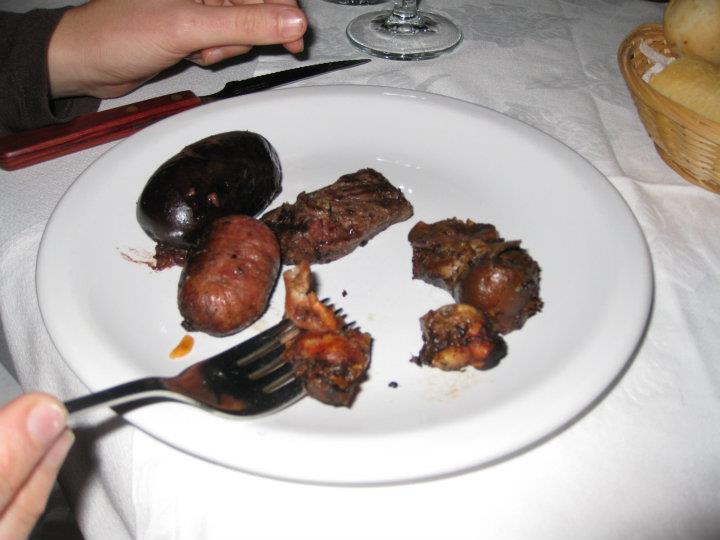
While made a few more small steps of food tasting in the name of one large step for foodiekind. Some of the more intriguing elements were cow kidneys, a new type of blood sausage, cow gullet, and cow intestine. The blood sausage was lumpier and less intense than what I’d been given at my first homestay; I rate this an improvement. I couldn’t finish the kidneys, thanks to their overpowering flavor. The intestine itself had no offensive taste, and was overcooked to be very chewy. Victory went to the gullet, which I really just remember as being kind of soft.

I also came to realize that in regards to alfajores, the maicena kind is where it’s at. These are more likely to have a thicker dulce de leche filling, instead of a token coating, and the dense cookies of these don’t taste artificial, unlike the average kiosko alfajore.


If I remember correctly, the dark one is blood sausage, and the kidney is speared on the fork. 

Sunday, November 6, 2011

GayZombieLaws

                                          Yum yum diversity.
Gay Pride

Yesterday, I went to a gay pride parade, which turned out not to be a parade, but a plaza full of stands selling rainbow colored goods. Given Argentina’s love affair with fairs, it was actually rather fitting. A few of the more interesting merchandise included rainbow colored alfajores and chocolate popsicles shaped like penises.  The event also attracted a few elaborate costumes, such as a woman dressed solely in one yellow thong and gold sparkle body paint, and a variety of drag queens.  (One man, dressed in a dominatrix costume, was immediately encircled by cameras. He kept having to turn and turn to face each new camera that surrounded him. I felt like I was watching  a captured animal, that instead of frightened, was sultry). 
Gay pride is different in Argentina, where although prejudice still exists, gay marriage is legal throughout the country. There was one stand protesting against the church and calling for a greater separation between church and state, which leads me to believe the marriage is still a big issue, just civil unions are legal. Still, the focus of this event was transgender people. They are not allowed to change their national IDs to state their preferred gender, which in many ways can make them easy targets (as any police can see, for example, that Laura looks feminine, but her ID still says “male”), and it can cause hassles. One of my friends’ professors at the UBA is transgender, and the bathrooms are swipe-to-enter. Though the professor looks male, he can only access the women’s bathroom, and the police have been called on him twice for being a man in a woman’s bathroom. (Why you would call the police about this is another question . .. .). Tuesday, the government votes to change this transgender-ID policy.

                                 The fair! I still find it odd to see alcohol sold at booths
Abortion
Another vote that recently failed by just 2 signatures was to legalize abortion. Right now, you can only have an abortion if you are both mentally disabled and raped. (It used to be either disabled OR raped, but in a rewriting of the constitution, someone changed it. Or thus says my history teacher).

Economy
In other legal news, a few days back Argentine prohibited it’s people from buying U.S. dollars. The peso’s value is based on the dollar, so many people, not trusting the Argentine economy, have been just buying dollars hoping they’re more secure and because they’re rising in value (much like we’d buy gold). It’s also important, because here you can only make major purchases in dollars (for instance, buying a house), and other countries won’t accept pesos, so if you travel to Uruguay, for example, you’ll need to change currency first.

I’m not quite sure why Cristina blocked purchases. According to an economist I met on the street, it costs a government a lot to keep buying foreign currency to supply to their citizens (likely that, just like banks mark up the price when they sell you currency, other countries do this too). Also, forcing people to use pesos means that money stays in Argentina and gets invested here, instead of sent out of the country. Still, the lack of being able to buy costly things is going to be a major problem.

School
Friday there were only about 7 students who came to the school I help out with. It turns out, the teachers in the village are on strike so the kids neither have classes or homework. Apparently this is common; the teachers are always negotiating better deals, and if they don’t like the compromises, they strike. I know in the U.S. some Sates legally prohibit teachers and other public employees (like postal workers and police) from striking.

Zombies
The lack of marching at the gay pride parade also reminds me of the lack of walking at the zombie walk last weekend. It seems Argentines are a sedentary people. The zombie “walk” was still an interesting event: a plaza full of costumes, and Argentine geek culture. Those who didn’t dress up often wore metal band T-shirts (Iron Maiden seems to be popular here), and I caught a glimpse to El Eternauta. I didn’t dress up, but I did dance Thriller.

Saturday, September 3, 2011

Día: 1 Month+

I.               Famous
Thursday we found the Catedral, a famous cathedral, especially notable for its ability to hide in plain site. The outside of the Catedral looks more like an old bank – a large square building with pillars and a decorative top. Once inside, it transforms into a huge, multiroom church, complete with choir music playing. Mostly, it was pretty, but there was a life sized figure of a saint that I found rather tacky. It was also interesting that the confession section was not at all secretive – whereas in some churches you can’t really see the confessor, here the confessors’ head and torso where completely exposed, making  admitting your guilts a much less private act.

Earlier that day, my program visited Teatro Colon, a large, rather ornate theater, full of marble and gold fanciness. It ha one of the best acoustics in the world, which I got the impression was half do to luck and half to to conscious placement of cloths to absorb sound and metal flowers to reflect and spread sound. The first architect who started on the Teatro died at age 44, and so was replaced by another man, who was killed by his wife at 44. Fearing that all the architects were doomed to die at age 44, and that the theater would never be built, those in charge made sure to hire someone 65ys old to finish the job. 


II.               Fairs
Buenos Aires is also full of fairs, many that happen every week and a few for special occasions. Last week I went to the Ferria de los Matadores, in an area traditionally known for its slaughterhouses. There was folk dancing, which everyone generally voted a lot more reasonable than tango, and lots of stands selling crafts and food. Today I went to a fair in honor of Immigrants. There was more folk dancing, and minor acts, as each country’s booth tried to lure you over.


III. Music
Monday I saw Afrolunes, an event that takes place in a bar every Monday, and features live music. I left at 1am, too early to see the African music, but the band before that was fantastic. The singer was full of presence, and, surprisingly, sang only in English, ranging from “I Shot the Sheriff” to the Red Hot Chili Peppers. American music is popular here, to the extent that at the concert I almost forgot I was in a foreign country. In the background they played clips of animations and what looked like odd B movies, for reasons unknown to me. Probably what I appreciated most was that a good number of people were dancing, and not grinding.

IV. Sports and Death
Earlier today, I went to see two polo matches, one men’s, one women’s. It was a beautiful day for it, but it seems Buenos Aires isn’t as into polo – despite being the semifinals the stands weren’t even a quarter full.

Later we went to a murder mystery dinner,  which was pretty fun, and I appreciated the caricatured characters, but it was hard for all of us to piece together the Spanish and figure out what was going on.

VI. Language
A few decades ago (80’s mostly) there was a lot of government run torture and it’s worked it’s way into the language. Phrases like “stop cutting my face” or “don’t give me to the machine” (“machine” referring to electric prod developed for torture)
are used to mean “stop bothering me” (at least, according to my readings, I’ve never heard anyone say it).

People even have PTSD over language. For instance, in the Dirty War, or the Process, as they call the period of government run kidnapping and torture, hoods were kept over captured people’s heads to make them feel powerless, or to suffocate them. One woman who had been tortured reported that years later, she was trying to tell her kids to remember to put up the hoods of their coats because it was cold. She couldn’t bring herself to say the word “hood”, so substituted a really antiquated term for it, and the kids had no idea what she was trying to say.

VII. Politics

I have more information on the deal with Cristina and the houses.

The Mothers of the Plaza de Mayo are a civil rights group that formed to protest the government run disappearances  during the Process. In the beginning it was specifically mothers calling for information on what had happened to their children. Now, the group has split into 2, and at least one faction is more involved in general rights work. Cristina Krichner gave a lot of money to the Mothers to sponsor their building houses. However, Sergio Schoklender, (irrelevantly famous for killing his parents), was the financial manager of the Mothers and  embezzled the majority of the money.