Countries

Showing posts with label travel. Show all posts

Tuesday, January 3, 2012

Mendoza: Bicycle Tour


 The land of bikes and wine is a nearby town called Maipú. (Having lived in Buenos Aires, I started to realize that Argentina obsessively recycles street and town names. No, towns don’t have a main street. But they almost all have an Uruguay street, or a Maipú, or a Yrigoyen. Every province and town pulls its name from a very limited set of sources: Argentinean presidents, nearby countries, and Argentinean provinces. Occasionally I’ll be surprised by a John F. Kennedy street, but never something so useful as School Street, or even anything as descriptive as Fountain Road. Someone, somewhere, is just not trying).
Visiting places dedicated to getting you tipsy, or at least show you a good way to get tipsy later, and in between traveling around on a vehicle entirely dedicated to balance sounded charming. And it was. Fortunately, the travel time between wineries was long enough that I never got really affected, though some other tourists did. (For the most part, Stephanie and I biked around alone, though occasionally we met up with other tourists making the same popular trip. Being foreigners together makes people amazingly friendly).

The places to go
            1. Our first stop was Museo del Vino La Rural, a free museum that gave us a tour of the history of wine making, their own groves, and finished off with a glass of their home-made (well, museum-made) wine. This sweet red wine was one of my favorites from the trip. Both informative and experiential, with a lot to see, this museum was a good place to start of the trip. Especially because I didn’t drink wine often, and really didn’t know anything about it except that it somehow makes you classy.


History
Here’s what I’ve learned about wine (from Museo del Vino La Rural and Familia Di Tomaso tours). Wine – and grapes – came over to Argentina from Europe, notably with Jesuit missionaries in the 1560s. The Spanish brought the first wine, but the French brought the grapes used to make Malbec, Argentina’s most famous variety.
Originally, grapes would be picked by hand and collected in large leather sacks, which didn’t coddle the grapes very well, and let a lot get smushed, and the remaining grapes would be juiced by being stamped on. Later, around 1850, they upgraded to scissors to cut grapes off the vines, and hand-cranked machines to crush the grapes and extract the juice.
            It takes about 2 kilos of grapes to make one bottle of wine, although of course, the amount varies by the type of wine. Red wine uses both the skins and the juice, while white wine only uses the juice (hence the light color). Nowadays the left over skins are used as fertilizers or to make oils.

Is it good?
Wine quality varies based on how the ratio of skin and juice used, how much of the sugar’s been let turn into alcohol (you can rate on how sweet it is, how smooth it is, and on how fast it gets you drunk), and what kind of oak (if any) has been used to age it.

Growing
Roses are planted at the front of each row of grape plants to act as basically the canary in the mine. If the rose plant starts to die, chances are you’ve got a pest that will attack your grapes next. One grape plant, at least in regards to Malbec, is good for 50 years. After that, it loses its sugar content.

Aging
Argentina has no oak of its own, and imports from the US and France, and, to a lesser extent, China. Wine ages as it is allowed access to air, which is granted by the space between the barrel’s slats and by the pores in the cork. (This is why wine bottles are stored pointing down, so the wine stays in contact with the cork). Admittedly, the more it’s exposed to air, the sooner it turns to vinegar, but with barrels and corks, the affect here is negligent. If you deliberately don’t want wine to age, you can use a plastic cork. Don’t think you can dump your wine in your basement then pull it out decades later. Malbec wine only last 3-5 years before it becomes vinegar.
The oak also gives extra flavor and aroma to the wine, which really does a lot for the experience. To give a smokier flavor to the wine, wineries might toast the wood. French oak adds flavors of tobacco and coffee, while American offers vanilla and coco. (French oak is actually stronger and harder than American, another tidbit useful in distinguishing them). Some makers will mix the wood in their barrels, alternating slats of each tip of oak.
            Proto-wine, my term for the juice (and perhaps skin) mixture that hasn’t yet become a drink, needs to sit until 25% off its sugar becomes alcohol. It takes about 20 days for white proto-wine to mature to real wine status, and needs to be kept at 10 degrees Celsius. Red wine ferments in about 10-15 days, at 20 or 25 degrees Celsius (room temperature). The temperature of the wine rises during fermentation.

The process seems interesting, and if it didn’t take so long/cost so much (I wouldn’t bother if I didn’t have oak), I’d try my hand at wine-making.

2.             We next stopped at Entre Olivos, which had tastings of olive oils, jams, dulce de leche, and other spreads. Many of their spreads were fantastic, especially a coconut dulce de leche. The place also included liquor tasting in the price. Some of the flavors were nicely sweet and thick, but we were surprised to realize they went down a little rough. The best (smoothest) liquors we tasted in Mendoza were offered at just a random artisanal booth in a median in the city street.

3.  Our next stop was Familia di Tomaso, recommended to us by the bike rental place. This stop was particularly great because, in addition to a brief tour of the winery, which seems to have been in the family for generations, they sat us down and showed us how to taste wine. First, they brought out an un-aged Malbec. Smell it, then swirl it around and smell it again, our guide told us. Now you’ve released the alcohol scent. Our guide described the Malbec as a fruity red wine, with a light flavor of plums and other fruits. They followed it up with a Malbec aged 6 months, which simply had more to it. The scent was spicier and the flavor fuller, smoother, and more subdued, with darker undertones. In one of the other wines, he told us to notice the tannins. This compound, found in the grape skins, dries out the inside of your mouth. I did feel a dryness or a puckering inside my mouth, but that could easily just be due to drinking so much wine. We also tried a dessert wine, which most of the tourists loved; to me it tasted like the cough syrup I had as a kid.

4.  We stopped by a few others, but at some point, all wineries seem the same. They all offer tastings of the classic wines like Malbec, and a tour. We decided not to explore many of the wineries, as we’d already got a fair education in.
 We stopped at just one more winery (I think it was Trapiche). This one gave us 4 full glasses of wine to split. I jotted down notes as I tasted, because for me, I process the experience better and pay more attention if I’m trying to explain it. Merlot was a dark red wine, thicker than Mablec, with a richer, although bitter flavor. It was less fruity than Malbec as well. For comparison we tried a light purple wine called Syrah. The flavor was lighter as well, lighter than Malbec, and acidic and citrusy. None of the wines we’d had that day had been white, so we ordered Torrentes and Chardonnay. Torrentes we were obliged to try, because it’s unique to Argentina. I didn’t particularly like either of these; they just seemed to have less flavor than the reds (but Stephanie insists these were poor samples). The Torrentes was a light gold, and bitter. It had a weaker flavor than the Chardonay, which tasted slightly acidic and smelled slightly fruity.

5.  Our final stop was Historias and Sabores which did not have much in the way of historias, but held through on the sabores (flavors) promise. I was still curious in liquors so we stopped here to try a few and try their spreads. It was a picturesque little place, with a patio outside the small storefront, and a view into their garden and grape vines. Their most interesting item: a thick syrupy Malbec spread.


All in all, I feel like my Mendoza trip was a lot of trying food, and wandering outside. A nice relaxing break after farming, and a nice way to end my time in Argentina. The next night I spent on a bus back to Buenos Aires, then I hit the airport insanely, irrationally early, and returned to the USA on an overnight flight.


Travelers’ Tips:

Bicycle Tour
Mendoza is famous for its wine, and, in the tourism world, almost as famous for its biking-wine tours. There are a few ways you can go about this: you can pay your hostel to “organize” the trip, or you can go straight to the nearby town of Maipú and do it yourself. Back to useful information: at least with my hostel, what you get when you pay is a car to come pick up you (and anyone else paying for the same service) and drive you to Maipú, pick you up again the end time the service has chosen, and rent you your bicycle. It’s honestly just a waste of money. Your other option is to take a normal city bus  (number 173) to Maipú (costing about AR $2), and once there, rent the bike yourself from one of the numerous shops. It’s been a while since the trip, so my memory for prices may be off, but I believe the organized trip cost about AR$90 and the bike rental itself only AR $25.

I rented a bike from a place called Mr. Hugo, which is immediately across the street from the bus stop. The bikes were pretty good and the seats relatively easy to adjust by yourself. I saw helmets there, which I presume they’ll give if you ask; I honestly just forgot. Some bikes had a basket in the front, so if you didn’t bring a backpack and want to pick up souvenirs, that’s a good option.  They give you a glass of wine at the end of your trip, and a brief map of places at the beginning.

Most bodegas (wineries) cost AR $20 for tasting and a tour.

If you’re hungry for empanadas, stop by the Beer Garden off of Mitre street: they’re made fresh and in meat and vegetarian varieties. Be prepared to wait though. 

Mendoza Day 1: Wining, Dining, and Generally Touristing


Plazas, Sundays, Parks, and Snakes
After a few weeks on the farm, Stephanie and I made for Mendoza city, the province’s capital. It’s a remarkably liveable city: unlike the endless Buenos Aires, whose borderlines seem more the stuff of legend than of reality, Mendoza is easily walkable, and adds to that more open and green space, and notable tilework in the plazas. When we headed for the city there was only one thing on my to-do list: bicycle wine touring. Which meant we were at a bit of a loss for what to do with our other day and half there. (If we’d planned further ahead, we could have taken advantage of rafting, hiking, or adventure sports in the area). As it was, we turned out to be pretty lucky.
            Our first night in the town we found a rock concert to raise attention to AIDS and sexual health taking place in the main plaza. For dinner we sampled the wine Mendoza is famed for, and got perhaps the most stereotypical meal possible: steak cooked in wine. (Another dish on the menu sounded like Argentina’s response to the Atkin’s diet: pizza with a steak instead of a crust.)
            The plaza is a very active place, and, it being Argentina, home to some impressive crafts stands. On a later night, we stumbled across a live tango orchestra, celebrating the famous tango singer Carlos Gardel’s birthday with a show. Audience members of all sorts, some dressed elegantly, some wearing sandals and street clothes, paired up to dance.
            Our first full day in Mendoza was a Sunday, an unfortunate mistake. We wanted to visit some wine tasting places, but most shops shut down on Sundays. (Speaking of wine, for those of you who would rather eat your drinks than drink them, consider trying Malbec ice cream, a flavor that came in season in my last few days).  We flipped through my guidebook and decided to check out a huge park in the area. It’s quite pretty, with many nice places to walk, and dotted with playgrounds. If you’re looking for a picnic area, a way to occupy young kids, or just want to see some nice nature, it’s worth a stop.
            Now, what we were looking forward to next, was seeing an ancient aquarium. My guidebook described it as an “underwater freak show” of preserved oddities from the sea, and suggested that the aquarium was likely unchanged since its installation in 1945, save for the level of algae on the glass. With a description like this, I couldn’t resist. Reality, however, could. We had chosen to come the year that someone finally decided to renovate the aquarium and it was closed to the public. Across the street, however, was a little snake-etarium, hosting a variety of snakes, a few large spiders, and other reptiles. Much of the charm was in the posters, which disproved snake stereotypes I had never heard of (snakes do not, in fact, drink cow’s milk, for example) and underlined that the only way to deal with snake venom is to get treated with an antivenom (do not try to suck out the venom, don’t apply a tourniquet, don’t cauterize the bite, drink alcohol if you want but don’t expect it to help . . . ). A few interesting facts I gleaned are that snakes are deaf, and that to make an antivenom, a scientist injects a small amount of diluted venom into a horse, removes some of the horse’s blood, and separates out the antibodies.
       We also made a stop by the Modern Arts museum (Museo Municipal de Artes Moderno) , located in the plaza. It was tiny, about 1 room, with a few nice wood sculptures, some obvious photoshops, and a less-than-inspiring very abstract movie. Not worth your time.

--
Traveler's Tips:

Guidebook
I have a Lonely Planet guidebook, which has been rather useful. The latest edition doesn’t include street numbers in its maps, and is usually off on price listings, but has handy details like phone numbers and street addresses. Everyone in my study abroad program owned Lonely Planet, which suggest its either good, or trendy.

Snake-etarium
There is some more exact and legit sounding name for this place, but I don’t remember. It’s worth an hour or so, and is cheap, only AR $7, if memory serves.

Tuesday, December 20, 2011

Farming Part 3

A Shit Day
One day we were assigned to clean out the pig pens, i.e. shovel shit. It was somewhat like cleaning out a diaper from the inside. For this sort of task you can’t help but swear constantly, and every swear rings oddly literal. At first, as we raked the pig droppings on top of the pen’s earth floor, it didn’t seem too hard a job. That was before we realize it was shit all the way down. Our first pen was packed, dry waste. Our second pen was only 1/3 a thin peninsula of earth; the surrounding sea was wet and stinking. It took us 6 hours, and what we moved was the build up of 1 month.  
            To be honest though, it wasn’t that bad. It was disgusting, and I was appalled by my own smell, but it was also funny. And neither as hot nor as tedious as weeding.

On Usefulness
One thing I really liked about working on the farm was that at the end of the day it was obvious I had done something tangible and worthwhile. It also meant that I didn’t feel oblidged to talk much at meals or be entertaining, because I felt  like I had already contributed. One reason there may be less depression in developing nations is that they feel useful even if they have bad jobs. Luis teased his son that if he didn’t pass his exams he’d have to be a train driver. That’s still a lot more valueable to society than the crap jobs I’m used to seeing like telmarketing, working at McDonald’s, or being a clothing store salesperson.

I was also a fan of not having to look nice. Being on the farm and camping, clothes only mattered for function; I felt like I’d done well if I just showered or brushed my hair.

Farm Summary
The sort of tasks I did were weeding, harvesting garlic, planting beans, harvesting lima beans and peas, shucking garlic, feeding animals, raking compost, distributing compost, shoveling out a pig pen, washing dishes, deepen irrigation channels.

The plants grown on this farm included: apples onions, two types of garlic, carrots, raspberries, lettuce, zaptillos (a type of Latin American pepper), cucumber, berries, artichocke,  quinece (a type of fruit resembling a large pear), chives, oregano, sunflowers, parsley, and corn. They raised pigs, rabbits, chickens, and sheep.


Farming Part 2: Pigs


Boisenberries
We started working once we arrived. Laura assigned us neating up the boisenberries. The  twisting branches of the plants were twined around weeds, and we had to straighten them out and tie them to a frame for easier harvesting. We spent that afternoon stabbed by the thorny branches and bitten bloody by flies. (Stephanie advised me to pull the thorns out with my teeth; I never got the hang of this, but trying to bite the thorn hepled because my teeth would depress the skin around the thorn, making it easier to then grasp).

Efficiency
What impressed me about the farm was it’s efficiency. We spent 6 or more hours a day weeding (so much that I have callouses), and all the weeds went to feed the pigs, rabbits, and sheep. The animal’s waste and leftovers from our meals went into compost.
Even our own waste was used. For a bathroom, we had a sort of dry outhouse. After using the toilet, you’d dump woodshavings/sawdust down the hole to trap odors; it was bascially a litter bin for humans.The hole of the toilet emptied into a large metal bin, which Stephanie and I had to empty on our last day. It was a two person task to pull the bin out from under the outhouse and carry it over to the compost pile to dump it. (For some reason human waste always seems grosser than animal waste, though its essentially the same thing).


Pig Food

It had surprised me that pigs could eat grasses, but apparenlty, pigs will eat anything, including each other. When we first arrived we saw one small pig penned off from his fellows. This one was a pig set aside to be killed. The farmers had cut off his gentials because it would sour the meat to kill him while they were still attached. He had to be kept separate for a while because if pigs smell blood on another pig, they will eat him alive.
The genitals and testicles are removed 7 months before killing the pig (they usually kill pigs in winter so the natural cold will help preserve the meat longer). The famer either cuts the genitals off with a knife or fastens an elastic around the genitals and keep it their until they fall off within a few days. Either method sounds intensely painful. (Trying to refer to the pig I accidentally called him “el chancho castigado”, which does not mean “the castrated pig”, but rather “the punished pig”. Laura loved this term).


Escaped Pigs
Sometimes pigs would be lefted in a pen in the fields to eat the weeds and roots there and thus clear the ground for planting. This was actually a dangerous idea, because sometimes the pigs would escape. On my eleventh day at the farm, a piglet got free in the field. Everyone in the field gave chase. I ran over in time to block one path of escape and the pig wheeled around, racing, terrified. Luis was furious and threw a hefty stick at it. He missed, grabbed his stick, and finally closing in on the piglet smacked it in the back until it’s legs gave out. Then Luis kicked it. The piglet tossed it’s mouth open and screamed. Luis grabbed it roughly by the ears,  hoisted it into the air, and carried it back to the pen, where he threw it on its back. For several minutes the piglet still couldn’t stand up. It was horrifying to watch.  
For some reason, loose pigs, unlike loose lambs, are a problem. I think the fear was that it would mess up rows of plants (presumably piglets step harder than lambs), and that it would not return (pigs aren’t exactly loyal to a herd).  Yes, the pig was a threat to their livelihood, but there are other methods of recovery. I’d seen Luis carry another pig back by the arms and legs, not the ears, and they catch large pigs with a collar on a rod that they hook over the pig’s head.

The relationship between a farmer and an animal is intensley disorted by the fact that the animals are meant to be eaten. Pigs are intelligent creatures, and I don’t doubt they could be trained like a dog could. Instead of trying to beat pigs into submission, it occurred to me that Luis could try to train them not to leave the pen. Then I realized that, given that the pigs will be eaten in some years anyway, it’s probably just not worth the effort. When a dog bites, humans try to understand what factors caused this (stress? illness? bad training?) and in some way negotiate with the dog, be it through a punishment-reward system or through removing the stressor. When a pig bites, they just kill it next.

Pigs are Awful
People have tried to tell me that English idioms slight pigs. No, English idioms are right on.  “Being a pig” is a perfect metaphor. Pigs who had just been fed and still had a pile of weeds next to them would try to eat their neighbors food if I placed it too close to the shared wall. Once a little pig even jumped through the gap in a wall to steal food from a bigger one, and pigs paired together to mate would fight for access to the food until one was beaten into submission. 

Farming Part 1


Before going to the station to catch our the bus to Mendoza , I dropped by the dormitories where my co-WWOOF-er to be, Stephanie, lived.  
            As one of Stephanie’s friends chatted with us about our trip, it soon became clear that we running optimisitcally and blindly to an unknown province. We did not know what sort of work we would be doing, what sort of farm it would be on (“there’s a lot to do” was the only description I knew), what the town was like or who the owners of the farm were.
            “The person I e-mailed with is a woman,” I offered.
            “At least that’s what she says.”
At this point the friend offered to loan us her knife. (We turned it down).

A bit of background:
WWOOFing is a program where anyone can volunteer to go work on an organic farm, for any amount of time from weeks to months. It cost $40 to join the WWOOF website, which then provided me with a collection of e-mails of farms who I could ask to let me work for them. This program runs throughout the world (a friend WWOOF-ed in Hawaii for a summer) and differs by farm. 


Sheep are Odd
When we arrived on the farm (after our taxi first accidentally brought us to another small organic farm), the first animal I saw was a sheep, leashed to a pole.
            “Is it female?” I asked, and they laughed at me.
Between it’s legs hung something pink and huge. I thought it was an udder, turns out it was balls. (In my defense, the balls are the size of two bannas hung together, curves pointing out, not very different in size from actual sheep udders). The male sheep, one owner of the farm told us, was kept separate from the females, and only allowed to have sex with them once a year.
Part of why I’d gone to a farm was because I wanted to fill in the gap between the packaged meat and the living animal it came from, and then decide how I felt about it morally. Trying to find some framework for judging how farm animals were treated, I kept asking about how sheep lived in the wild. There are no wild sheep, Luis, the other farm owner, insisted, they were a completely domesticated species, and had adapted to be so. For instance, sheep grow coats so thick they suffer from heat if no one shears them each summer.
            Still, something can be inferred about the animals that evolved into modern day sheep. For instance, according to the evolutionary psych books I was reading at the time (“The Moral Animal”), large balls imply a species in which femalse have sex with many males. Because they don’t monopolize any notable section of a female’s fertility time, the males instead try to overload her with semen, hoping theirs will beat out the sperm of the other males.
            A side note for those of you who think sheep make cute little “baa-ing” sounds. Most adult sheep sound as if they’re about to throw up. We had one cantakerous sheep who would stick out her tounge and bellow blehhhhh. (I would imitate the sheep all the time. This one and I got into shouting matches). Lambs, admittedly, are cute, if very very sad to watch. Every day two or three lambs would escape the sheep pen through gaps in the walls, and go frolic in the greater farm land. Then they would realize that they forgot how to get back in, and would cry. (Baby sheep make a high, mewling “mehhh”). Even when one lamb would find a way in (and there were many), his/her friends wouldn’t follow but instead would stand on the other side, bewildered. It is as if there is something fundamentally wrong with sheep language.  


Routine
The farm was owned by a husband and wife couple, Luis and Laura, who had previously worked as a kindergarten teacher, and I think, an electrician, before deciding they preferred farming. They had four children, ages 16-22, the eldest of which lived in the city while going to university. Our farm was a 40 minute walk from the town of Tunuyán, and bordered by other family farms (hence our taxi getting lost).

Stephanie and I slept in a tent we’d borrowed from her cousin (most of her family lives in Argentina) with a mat and blankets the family lent us. We soon settled into a comfortable, if not exactly thrilling, routine. Luis and Laura would wake us at 8am, and give us a breakfast of tea with bread and jam. We spent the mornings weeding, and feeding animals until 1pm or 1:30pm. Lunch was with the parents and their kids, then we’d take a siesta, because Mendoza province gets hot enough that you need to. Usually I’d read or nap until we returned to work at 5pm, and we’d keep working until it got dark, usually around 8:40pm.

A nice part was I really did feel accepted by the family. They’d joke and tease us constantly (me for my American-accented Spanish, and for getting smudged with dirt while working in the dirt) and on Thursdays after dinner we’d watch movie on TV with the family.
                                           Our part of the farm

Friday, November 25, 2011

Next Phase: Mendoza

Finals ended this week, thankfully, and last night was my program's goodbye ceremony. (Located at a surprisingly ritzy place, where two types of celebration fused: the dance party disco balls and music mixed with with an elegant dinner party scene with waiters politely carrying appetizers).

Now I'm off to volunteer for 18 days on a farm in the province of Mendoza, known for it's wine and, unfortunately, I'm learning, for being even hotter than Buenos Aires in November. It is sweltering here, with a high humidty, yet Starbucks has started putting little ice skaters on its advertisements. I'm volunteering as part of a WOOF program, where I'll work 6-7 hours a day and get free meals and shelter (I'm camping with a friend from the program). The town I"m going to apparently has very good apples, and I think that's about all I know. Wish me luck!

Thursday, November 17, 2011

Tourists like lists (or so I hope)


I think it's time to give a shot at writing something more touristy, so here goes: a set of list and tips for anyone vacationing in the city.

The Fairs, ranked

1.     Ferria de Los Inmigrantes – this is not a regular fair, but if you’re around in September, it makes a great lunch spot.  You won’t get the South American feel, because countries like India, Germany, Russia, and more are represented in the booths, but this fair is one of the few not aimed at tourists. Whereas San Telmo is teeming with souveneirs, the main things to buy here are food, and hats, clothes, and trinkets from other countries. What makes this fair stand out is the dancing. A stage is set up in front of a perfect picnic spot, with dancing and singing throughout the day. Smaller dances seem to break out randomly among costumed members of other booths.
2.     Ferria de los Matadores: There’s dancing at this fair, too, though it’s less diverse. The dance is a folklore style, accompanied by music, and I heard rumor that sometimes the fair has horse tricks, though I was disappointed to find they weren’t happening the day I went. It seems to be luck of the draw what you’ll get to see. While this fair is also touristy, full of leather belts, wooden flutes, chocolate, cheap bread, and alcohol, the prices are excellent (a bottle of wine for 13 pesos, for instance).
3.     San Telmo fair: This fair happens every Sunday and is notable for its sheer size. The fair consumes several city blocks in many directions, and you can walk for hours still seeing new things. It is a very touristy fair, and there’s a pressure to shop for souvenirs the whole time. Here and there in the fair will be musicians playing guitar or even on a metal bowl, and mimes for children. Some cool highlights were boxes made out of a single orange peel, the ubiquitous soft wool sweaters with llama designs, and some delicious homemade pastries from a woman pushing a cart.
4.     Tigre’s Fruit Fair: this fair on the river offers good fruit smoothies, and a large collection of items ranging from earrings to furniture in the nearby shops. None of it’s items are truly unique, but you can get cheap yerba in bulk, and lots of fruit.
5.     Ferria Recoleta at Plaza Francia: This is another weekly fair, and a nice place to peruse on the way to the cemetery or one of the nearby art museums. All the products are touristy, meaning a quick way to pick up souvenirs, but a bit pricier just for that reason. You’ll find things like mate gourds, leather belts, and shirts.
6.     Gay Pride Parade: This gets listed last because it’s a special, one-day event. From buttons to alfajores, everything’s rainbow, and you’ll see some “intriguing” costumes.

If you’re interested in shopping, there are always the malls her (called “Shoppings” by the Argentines), but they’re likely to be pricey. They’re much more elegant and elaborate places than those of the U.S., and if you decide just to go to check it out, it may feel like you’re walking in a hotel.

Best Museums
1.     Evita Museo: If you love culture, this is for you.
2.     MALBA: a Latin American arts museum with a huge and diverse collection, ranging from traditional to abstract and modern.
3.     Museo Bellas Artes
4.     Recoleta Centro Cultural
5.     Trelew: Egidio Feruglio Museo: a small museum, good for an hour or so, but with impressively complete dinosaur skeletons.
6.     San Antonio de Areco: Gaucho Museo: Ok
7.     San Antonio de Areco: Cultural Museo: Don’t even bother, though it costs about one dollar and no guards will stop you from touching all the exhibits.

Transport
1. In the Hand: Buy yourself a Guía T and figure out how to use it. The bus stops are confusing, as the book will only tell you what street to look on, not what intersection, but it’s the best hardcopy map I’ve been able to find.

2. On the computer: To get a closer idea of where bus stops are, look at the routes and the bus suggetions online at http://mapa.buenosaires.gov.ar/

3. On the streets: The train (subte) runs quickly and until 10:30pm. After that, you’ve got to find a bus, or give in and take a taxi. Only take Radio Taxis, because sometimes you can end up with a bogus taxi who will rip you off, or worse.

Food
1.     Lentil stew: it’s delicious; a thick stew, often with chunks of potato and beef.
2.     Mandioca: this root actually comes from Paraguay, but is popular here, no doubt for it’s complex texture. “Chipas” are a dense, bagel-shaped food made from mandioca flour.
3.     Alfajores: you’re obliged to try some, and they won’t be hard to find, whether you grab a packaged one from a kiosko or buy a fancier version at a bakery, and they vary a lot. The best I’ve had are AlfajOreos (this doesn’t really count: it’s more like a tall Oreo sandwich in a chocolate shell), maicena alfajores (soft cookies, thick dulce de leche filling, and rolled in shredded coconut), and a Vaquía brand alfajore well filled with a liquid Cappuccino filling.
4.     Empanadas: as with alfajores, you haven’t been to Argentina if you haven’t tried one of these. They come in a huge variety, the most common being stuffed with ground beef or ham and cheese. I recommend corn or caprese-filled ones.

Bars:
I’m afraid I haven’t been to many, so this list will be short, sweet, and under-informed.

1. Acabar: board games, restaurant, and bar. What else could you want? Try the “Spare Time” drink: it’s neon blue and sweet. What else could you want?
2. El Alamo: my favorite straight-up bar, because the people are friendly and mix easily. You can get about 2 liters of beer for ridiculously cheap (I’d guess $5), if you’re into that sort of thing.

3. Jobs: another board game bar, far more elaborate than the other. There’s pool tables, darts, and, if you go on the right days (Saturday, Tuesday, Thursday), even archery. If you arrive before midnight you can skip the 30 peso cover charge and get a free pizza.

4.Shamrock: An Irish pub that varies a lot by the day; can be so crowded it’s a fight to get drinks, or can be a good time.

5.Le Bar: I can’t say much for the drinks, because I didn’t order one, but the ambience is nice. The seating is sunk into the floors, the lights are low, and you can go on the roof. The time I went there was a band, too.


Monday, November 14, 2011

Pretty Places: Iguazú

This time we took a few days and went north, up to Iguazú Falls, which is currently a candidate for one of the 7 Natural Wonders of the World (there’s an on-going vote). I just got back this afternoon.

When atomic bombs had just roared into the world’s consciousness, people had no idea what they would do. They were terrified of all sorts of things: that atomic bombs would reverse the earth’s magnetic poles, or, my favorite, that they would blow a hole in the earth so big all the ocean’s would drain through. Iguazu Falls looks like this. All the water is just dropping away, cascading forcefully into a void of white mist. A few sparrows flit in and out of the fog of spray, the only small black marks on an endless white. 


Walkways have been set up so you can get close to the immense series of falls, and stand atop the point where river turns to falling rapids. Other walkways give you full views of the fall. Looking out at the palm trees, thick growths of vines and tall forests that cover the islands,  my friend Shaina said something I couldn’t agree with more, it was like being in the land of the dinosaurs. Still for me, while the views were fantastic, walking across an even metal platform to get there made me feel even more distanced from the experience, even more like a tourist.
I have a thing about texture. So much of daily life is visual, and everything seems to be smooth: chairs, tables, the computer mouth, the glasses, book covers. Modern society has a plethora of colors but little variety for the other senses. The point being, I wanted to feel that I was somewhere new, not just see it.   

We managed to shake things up a bit. We took a boat ride across one of the rivers. It was a peaceful affair, nice but not super exciting. That was our next boat trip. A speed boat brought us right under the falling water, so it pounded on us, making it almost impossible to open our eyes, hard for some people to even breath. I loved it. The water is relentless, and soaked us through, a welcome change from the humidity.
Back at the town we cooled off with some oddly flavored ice cream, including Kiwi and Yerba Mate.
Our second day was charged with thunderstorms, which cut short our trek through the jungle itself. This dirt path went to a waterfall where you could swim around, but we never got that far. Not swayed by my insistence that we probably wouldn’t be hit by lightning yet, a friend decided it was time to turn around. The mud was red like we’d found Mars, and the jungle grew thick around us. It seems tame from a wide path, but it must have been terrifying to be the first to hack through plants so thick they cut out almost all light.
As we began to head back, a coapi (kind of like a long-nosed raccoon) ran across our path. I had lost my camera case in Santa Tierra, so was storing it in a sock and a plastic grocery bag. I began to pull it from my pocket, thinking a coapi on our path would, honestly, make a nice addition for Facebook. The plastic rustled. The coapi turned. We’d been warned these creatures get violent around food and not to feed them. (Presumably coapi are like geese, in that if you offer geese a piece of bread, the birds assume this is it only because you have an infinite storage of bread to give them. If you do not then feed the geese to the point of bloating, they assume you are holding out on them and express this in a fit of bitey rage.). And coapi have sharp teeth. And claws. The animal walked over to my friend, and we both held very still. Possibly he (she?) smelled leftovers from lunch in her bag. I moved away and my plastic bag, now in my hand, inadvertently rustled again, which drew the coapi to me. I held the bag away from my body and let him examine it, thinking he would see it wasn’t food, and let us be. The coapi came to his hind legs and pawed the bag, and I let him take it. He tore it open and found a very non-tasty sock. The problem started when he grabbed the sock in his mouth and began to hop away, back into the jungle, taking my photos and pricey camera with him. Fortunately, when I stamped the ground he dropped it and wandered off a bit.
a different coapi, earlier on

Our third and last day, we found that rainforests do, in fact, rain.  It downpoured, which kept us inside a lot, playing endless matches of foosball. (Not really complaining there). There’s not much to do inside in Iguazú, unless you go to the shopping mall or casino. We braved the rain and went to Guira Oga, an animal rehabilitation center. Here, jungle animals who have been kept as pets or smuggled around are rehabilitated. (One set of monkeys had previously been pets. There mother was shot and they were drugged with water laced with wine then taken to be sold). They may be released again into the wild, but more likely they’ll just be taken care of in a more natural way and their children will be put back in the wild. Injured animals are also taken in, including one bird who’s jaw had been shot off by a hunter.
It was interesting to see the animals, all in large caged off areas. They were in pens in a jungle, but it wasn’t the same as seeing wild animals. The difference was, they weren’t afraid of us, and, more importantly, we weren’t afraid of them. I saw several coapis in the rehab center being treated for diabetes they had developed after eating tourist’s chocolates and processed food. My first instinct, glimpsed their fuzzie heads, was to think how adorable they were, before I recognized them as threatening little camera-thieves.
My favorites were seeing a toucan (not as big as I would have thought) and a type of monkey that looks like a bush. The bush-monkeys were huddle in the rain, just two furry spheres squatting on the handrail. Apparently the female monkeys are the territorial ones and will claim an area and a mate. We were warned not to get too close or the she would get angry; regardless whether your human or even another species of monkey, these females will see you as a threat. The bush-monkey had been give a trainer to help rehabilitate her (I’m not sure what the problem was) but the trainer was a woman, so she’d have none of it.


Traveler’s Tips


How to Arrive
Our bus was Crucero del Norte, and the best we’ve been on. The food varies from tasty chicken to airplane food (in a flash of Americanism, I dreamed of salad, and received fast food French fries and a Milanese covered in cheap cheese. Still, they give you alright food). The bathrooms are both clean and have toilet paper and soap (most bars don’t even give you that much). The buses to arrive and to leave both arrived pretty much on time, even according to American standards.

Where to Stay
We stayed at Hostel Park Iguazu. It was decent, with a full-sized pool, a foosball table, 2 computers, and hammocks. At least one of the desk attendants knew English, and the rooms, though small, were fine, save from 2 cockroaches.

(After our failed attempts to catch cockroach, a friend went to the desk, and not even trying Spanish, announced, “Bug. Big one.” The attendant gave her two plastic cups and a can of Raid. She came back: “It got away into the ceiling” she told him. “Why don’t you keep the can?”, he said.”)

What to Do
The tours we did are common and you’ll see a “Jungle” stand at the park offering them. The boat Eco tour down the river isn’t worth the price for just it (we got it in a deal with the other trip, costing only 35 pesos more). It’s not very exciting, and you can only hear the guide if you sit really close to him (and speak Spanish). You might see animals, but you might not. We didn’t.

The under the waterfall tour can be done for about 135 pesos or so, which we did, or combined with a  on the rapids ride and a jeep ride through a jungle, for 200-something pesos.

We were planning on paying 200 pesos to walk the Devil’s Throat (Garganuta del Diablo) path at night, but it got rained out. They’re very good at giving you your money back if you cancel.

I recommend Guira Oga, the animal refuge we went to. It cost 40 pesos, and is offered even in the rain. Our guide only spoke in Spanish, and wasn’t great about waiting until everyone was there to hear her, but you see cool animals, and it’s certainly worth the price.

You can get tickets to the falls and to Guira Oga at the bus terminal in the town for 10 pesos each way. Tell the bus driver when you get on if you want him to stop at Guira Oga.  You may be able to only pay 4 pesos just to go to Guira Oga, but the terminal will charge you 10 if you buy from them. I believe you can just hand the bus driver cash directly.

What to avoid
Even though the park's water fountains advertise 24hour purification, don't risk drinking the water. A friend of mine made this mistake, and it more or less took her out of commission for a day and a half. (I can't promise that this was the culprit, but we can't think of any other reason). She threw up that night, and didn't feel well enough to hike much the next day.

Brazil
If you're like me, your guidebook told you Americans can waltz into Brazil without paying a fee, if they only plan to stop over for the day. This, it seems, is a cruel cruel lie. According to our hostel and everyone we asked, Americans need to go to the Brazilian representative and apply for a pass into the country, which may take about a day to get and may costs about $100 or $140 (my memory fails me). This is a reciprocation fee, which Brazil charges because the US does the same to it. The majority of the falls are on the Argentinean side, and while going into Brazil means you see Iguazú from all angles, it doesn't offer you much that's new or different. At the very least, that's what I've come to feel after talking to traveler's coming over from the Brazil side: Argentina's section is just larger and more impressive. If you feel daring and don't have a problem with illegality, you can try taking a taxi into Paraguay (which is free), and from there travel into Brazil.

Paraguay
I didn't go there myself, but I've been told that area of Paraguay close to Iguazú is appreciated for very cheap goods, but not for sightseeing. Argentineans and tourists will cross over to stock up on clothes and souvenirs. 

Pretty Places: Tigre


About two months ago I took a weekend trip to an area called Tigre, with a group from my program. It’s a beautiful Argentine get-away on a muddy river (darkened by sediment, not pollution). The area seems mostly inhabited by vacationers and those who run businesses for vacationers, and is known for a fruit fair.

Right about now, in full summer, the area would be at it’s best, I think, because it will be warm enough to swim and the flowers will be more in bloom. As it was, it was a great place; we pedal boated and kayaked, walked around the woods, and played Scrabble in Spanish. 

Our program organized the hotel, and as we looked around at the 2 person luxury cabins in the woods we’d been assigned to, we realized we’d been placed into a honey moon suite. It even came with a sexy music CD and beds that slide together.

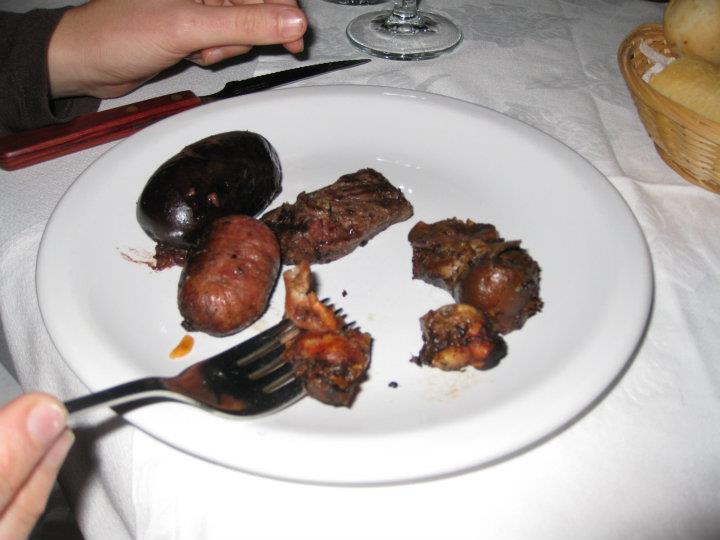
While made a few more small steps of food tasting in the name of one large step for foodiekind. Some of the more intriguing elements were cow kidneys, a new type of blood sausage, cow gullet, and cow intestine. The blood sausage was lumpier and less intense than what I’d been given at my first homestay; I rate this an improvement. I couldn’t finish the kidneys, thanks to their overpowering flavor. The intestine itself had no offensive taste, and was overcooked to be very chewy. Victory went to the gullet, which I really just remember as being kind of soft.

I also came to realize that in regards to alfajores, the maicena kind is where it’s at. These are more likely to have a thicker dulce de leche filling, instead of a token coating, and the dense cookies of these don’t taste artificial, unlike the average kiosko alfajore.


If I remember correctly, the dark one is blood sausage, and the kidney is speared on the fork. 

Wednesday, October 26, 2011

Spring Break Trip The Final Days: Ice and Dirt

Las Glacieres National Park/El Calafate
Possibly my favorite part of the trip was seeing the glaciers. They’re just . . . stunning. The mountains that rise on all sides look cut from a Japanese ink painting – all black and white, and infinitely dramatic. Beneath the zebra-ed mountains sits the glacier, shimmering oddly blue before a lake. We got postcard perfect view of it from a set of balconies, or platforms, set on the side of a mountain.
The glacier we saw, Perito Moreno, is bordered by a large lake on one side. When the glacier grows so large that it extends from bank to bank, it creates a dam. The blocked water rises to the tree line, and if any of the water manages to slip up under the ice, it begins to lift it up and erode it, making ice tunnels. This glacier is famous because it moves. It grows and shrinks in the seasons, and even as we watched it began caving: little avalanches of snow announced by a noise like a prolonged thunder boom.
Perito Moreno is named for the man who never saw it. Argentina and Chile were fighting over their border: Argentina insisted that the boundary line should be marked by the mountains’ highest points, while Chile claimed a river should designate the border. Moreno, through some means (digging, or explosives, or other techniques) forced a different river to shift its course. With this he proved that a river was an unreliable boundary. Argentina got the land it wanted, and Moreno got a glacier.            
Our next stop was a boat ride up to the glacier itself. Surprisingly, cows ate on the banks, undisturbed by the giant table of ice. The glaciers, like a bulldozer, shove the earth before them as they move, making hills of fine, almost powdery rocks, and larger jagged stones. Devoid of grass and plants, the land is like a natural junkyard. Glaciers bulldoze over mountains, too. When this happens they sculpt the mountain, as if the glacier was a giant nail file, shearing and tearing off the top, and leaving behind the classic fin shape.  
The glacier ice by the land isn’t pretty; it’s dirty, like city snow, from all the sediment blown onto it from the shore. We hiked through these earth piles, and into a woods. The trees were huge but many lay collapsed. One guide told me the culprit was very thin topsoil, combined with strong winds.  At our previous mountain, we saw calafate plants, the namesake of the town we stayed in. It’s a small, spiky plant whose berries are used in ice cream, jams, and alcohol. In both places a type of whispy green moss-like plant, called Old Man’s Beard was visible on the trees. According to our guides, it can only grow in air  where there is no pollution.
The glaciers are perhaps the purest place on earth. No plants nor animals live on them, save a small type of insect. When walking on them, you can snap off a piece of the thin ice that tops rivers in the glacier, and eat it, and if you were to drop food, the 5 second rule could stretch into 5 hours or more.
At the end of our hike the guides gave us hard candies, harnesses (to help them lift us out in case we fell into a crevice in the ice) and crampons. The ice near the edges of the glacier moves more quickly than the ice near the center, I assume because it is has more surface area exposed to the sun’s heat, to water’s currents, and to anything else the land can offer. This causes pressure and fissures, or crevices. People do fall into the crevices and die (thanks to harnesses, the guides could pull us out). Throughout our walk, our guides would stand right at the edge of any hole, prepared to catch us and keep us safe. I have no idea what would keep the guides alive if we stumbled into them. These men did have astoundingly sure footing, leaping and running on the ice while we tourists trudged along. (That they work 8 days in a row, before having a 2 day break surely has something to do with this.)
On the ice glacier itself, our crampons seemed to slot into the ice as if the shoe was one side of Velcro and the glacier the other. There is no real snow on the glacier, just ice and it makes a crisp, crunchy noise as you walk. (In comparison, the thin ice on the rivers has more of a tinkling sound as it breaks). On the return journey when I took off the crampons, walking felt so light and carefree. I was clumsy, tripping on rocks, because I no longer had to pay attention to where I put my feet.
There is water in the glacier, sections of rivers or lakes near the surface, where the ice has melted. Each part has a thin ice covering, and gleams a neon blue so vivid it seems unreal, like antifreeze or mouthwash. That was one thing I noticed, as I tried to describe my journey: all my vocabulary degraded it.  The glacier was like antifreeze, brush dotted the hills of Patagonia like a rash of pimples. I compare to what I know, and nothing I know is sufficient.
The whole trip, I was astounded by the glacier, and the mountains. The captivating expanse of dazzling white and a blue so unknown it seemed artificial. The mountains surrounded us on all four sides, their sharp planes of snow covering forest so dense it looked black. And yet all the while I looked at the mesmerizing scene, the back of my mind wondered if our ancestors appreciate the snowcapped mountains, or if they only saw cold and harsh and an obstacle to climb? In a way, seeing beauty in a cold, rough land feels like a modern luxury. From the safety of my world of airplanes and bus systems, I can afford not to worry about the challenge of a winter climb.
Vegetarianism, too, is a modern luxury. Thanks to an abundant supply of tofu, lentils, and milk and similar products, I can avoid meat and not die. I can even be healthy. Some people say we should eat animals because our ancestors did and so it’s natural. It’s true that in a world without veggie burgers, you got your protein where you could. I’ve always believed in the right of a species to exist; some argue vegetarianism in all cases, but I would never suggest starvation as an alternative to eating an animal. If it’s me or the turkey, the turkey dies. But for the middle class, vegetarianism is an option, a valid option, and that introduces a new kind of morality. In a world where your body and your wallet can afford not to kill an animal, where do we justify choosing otherwise? I don’t mean to preach, and at the moment, I eat meat, but I think it’s an interesting discussion. But, back to glaciers.
It was surprisingly warm being on a glacier. We were lucky not to have wind that day, which helps, and is an uncommon situation. Wind sweeps snow down from the mountains where it turns to ice down here. I was hot at times wearing a T-shirt, long underwear with snow pants, gloves, and a sheet-of-plastic quality rainjacket.
We stopped for lunch on the glacier, and the guides, who were wonderful and made frequent jokes about leaving us to die, gave us hot tea and nut bread. Nearby was a field of what looked like tombs of ice (there is a French name for this formation, but it escapes me). I had heard you could drink glacier water, and began trying to scoop ice into a plastic bottle (the water brand ironically advertised itself as “fresh from the mountains”). Seeing my pathetic attempts, one guide walked over and, taking my plastic bottle, plunged his bare hand into a river to fill it up. Glacier water tastes, honestly, like nothing. Cold, and free of any chemicals or minerals.
            On the boat ride back, they gave us whiskey with glacier ice. It was sweet, spicy, and syrupy, and it being Argentina, they gave us alfajores, too. I dipped mine in.

(The glaciers are 300-500 years old, by the way. I think that’s interesting, but found no smooth way to slip in).

Sunglasses want to be Philosophical Too
Sunglasses are an interesting invention, I think people like them, besides the obvious, because they’re a way to keep your surroundings at bay and domesticate the world. The make me feel detached from life, so I generally hate them. I heard they were a must for glacier hiking, so, too cheap to buy polarized, I grabbed a pair dark enough to make me feel unsafe walking in Buenos Aires. They were pretty handy on the glaciers, I’ll admit, though I didn’t wear them the whole time.

El Chalten

The second day we went to a popular hiking town, called El Chalten. For the longest time, I couldn’t remember what it was called, and just said, “We’re going to the mountain.” People stared it me like I was crazy, because in the Andes, you’re surrounded by mountains. There are a plethora of hikes, from 3 hours to 7 or more hours. The truly dedicated will camp overnight, others have to take the bus back by 6pm (Traveler’s Tip for you there). Apparently a small type of deer inhabit the area. Nature’s little joke is that these endangered deer are almost too cowardly to live. If they hear a dog bark or see it’s poop, they’ll flee. If a tourist rushes after them to take a photo, they’ll have a heart attack and die. They can’t drink from the same water as cows, or the germs will kill them. Suffice to say, we didn’t see any.

The mountains here were pretty, as any mountains are. Behind the rocky brown-and-green mountains we climbed on, the snowcapped majesties loomed, like the backdrop on a theater set. At a few moments we could glimpse the glacier shimmering blue in the distance as if it had been photoshopped into the scene. Even now, it felt impossible that it really existed. (A side not on science; according to our guide, glaciers are so blue because blue is the highest frequency wave. Perhaps it’s actually because it’s so short. The many facets of ice would disperse the blue wave, just like gas atoms in the air disperses blue across the sky).

The town itself must be only 200 people, in brightly colored houses, generally selling arts, food, or hiking gear. We did two shorter hikes, the last one up to a peak to a bird look out (though we didn’t see any; It was not our day for animals). The hills are covered with blond tufts interspersed with bushes so round they seem cut from a children’s book, these dark green and purple-gray blobs looking like a whimsical flock of sheep.

Traveler’s Tips: El Calafate

Trips
We went to a small town, called El Calafate, where many trips leave from for the glaciers. The trips are well known in the town, and your hostel can help you find what you need. What I went on was called “Big Ice”. It cost AR $870 (which is the same price as the MiniTrekking trip offered by the same company).

Equipment
Don’t worry about winter clothes, you can rent everything here. For 100 pesos you can rent boots, snow pants, a winter jacket, gloves, and hiking boots. I bought a pair of thermal mittens in Buenos Aires for almost the same price.  (you can get just boots for 40, and snow pants for 35). In general, what you need is waterproofing, not warmth. Walking builds up heat, and   I had the luck to go on a day without wind. I was fine in a t-shirt, long sleeve shirt, and a very basic rain jacket. I did wear snow pants, which is important, because on my trip, you sit on the ice to eat lunch. Also, hiking boots seem useful, I wore them, and  people will advise you to wear gloves, because the ice is sharp enough to cut your hands (I can’t confirm or deny this one). I do recommend sunscreen and sunglasses.

Travel
If you, like we were, are arriving from Puerto Madryn, there are two bus options. A brand new option is a direct bus, which I’d recommend. I didn’t take it, because it didn’t exist when we bought tickets. We took a bus to Rio Gallegos (17hours) and then switched to a 4 hour bus. Online, it looks like only 1 bus a day leaves from Rio Gallegos. This is lies and trickery; you will find several buses leaving throughout the day. Argentine buses are notoriously unreliable time-wise, and ours arrived 2 and a half hours later, making us miss our connection. Most other passengers seemed to just wait until they arrived to do that.

Water
Be careful about the water in Patagonia. In Puerto Madryn, our hostel host thought it would be fine, and I drank it with impunity but 3 friends got sick. One reported stomach pain, diarrhea, and constipation. Once she switched to bottled water, she felt better. In El Calafate the hostel told us not to try drinking it.

Food
One good restaurant on the cheaper side of what you can find, is 13 Gustos. It’s a s bit cheaper than anything on the main road, and they’re lentil stew is fantastic.

Thursday, October 13, 2011

Day 5: Elephant Seals

Our guide drove us out through more Patagonian emptiness to see the elephant seals in their natural habitat. To get down to the beach we had to descend a path that seemed to waver somewhere between “steep” and “vertical”. At one point we had to cling to a rope so we wouldn’t fall; the guide of course, galloped down like a natural. It’s an funny thing, the difference between U.S. and Argentinean safety laws. In the U.S. we could never have done something like this; likely there would be wider paths and secure guardrails, but at the same time, I doubt the US would have let us get as close to the sea elephants as we did, at least not without signing a waiver. As it was, we were able to get within ten feet of the napping  sea elephants (“elefantes” in Spanish). The elephants are named for the males, who sport a ridiculous nose. The females are more or less like large versions of female sea lions, but with red iris bordering a gigantic pupil.
 
20% of male sea elephants reproduce, and keep harems of 2-4 females. In general the male and the females, who were with their babies, might glance at us tourists, or even open a mouth and show off teeth, then go back to napping. The elephants spend 2 months in the sea, and 2 months on land; during the latter they essentially don’t eat. (Their diet is squid). The elephants we saw had also just given birth, so were more than content to lay about, recuperating and tossing rocks on themselves to cool down. I think the elephants realized that we tourists weren’t worth the energy it would take to chase us away. I felt like I was to the elephant what a bird is to a human: something you notice, maybe even keep an eye on, but really is no threat.

Babies stay with their mothers for 40 days, after which they get kicked out and live alone, until they mate when they are about 5 years old, and they die at about 30 years. The babies we saw were 2 days to a week old and had fuzzy coats that made them look like little black bears. Later, they’ll shed the coat as they get older. Adults, too, shed winter coats for summer coats. The fins of elephants have nails which are both used for scratching off old skin, and for fighting over mates. (The males sported an impressive collection of scars).

One little sea elephant was fighting with his mother over feeding. He kept whining a cry that sounded a bit like a squeaky toy: Eck-Eck Eehh! This mother wasn’t interested at all, and refused to roll over and offer her nipple (they only have one, and its small, the size of a belly button). It’s an interesting balance the mothers have to play, between keeping their children alive and not giving so much milk that they themselves can’t survive. I noticed one mother who was particularly lean, laying next to a rotund baby. I assumed that that meant that child was about ready to go out alone, but the weight differences could perhaps be that the mother had miscalculated how much milk she could afford to give.

The beach itself was entirely rocks, smoothed by the water. We saw a stiff, dead penguin, and a dead baby sea lion on the walk. The cliff we climbed was sandstone with some sedimentary rocks mixed in, holding shells and similar small fossils. When I examined a rock it just appeared to be sheets of sand packed together. It’s a powerful feeling when you can throw a rock and have it disintegrate. (Of course, this wasn’t the case with all the stone. Harder packed sandstone had a darker color and refused to snap in your hands).


Traveler’s Tip:
Seeing the elephant seals makes a good half day trip. My hostel organized this trip, and it was about an hour or an hour and half drive in car (the guide picked us up at the hostel) out to the point. There’s a few more tourists than other places, but by no stretch of the imagination is it crowded. Our guide spoke only Spanish.

Wednesday, October 12, 2011

Day 4: Penguins, Welsh, and Dinosaurs

First we went to Punto Tombo, a penguin reserve. It was a beautiful open land. The sky looks gigantic, extending without beginning and without end, and the sea sparkles and glitters as if full of drowned fireflies. Thousands of Magellanic penguins come here to mate and hatch chicks. The reserve is a giant collection of rocky hills on the side of the ocean, and penguins and guacanos roam freely. The park is a brilliant set up – visitors aren’t allowed to interact with the penguins, merely to walk a set path through their natural territory. You may not take anything from the park – not even a feather or a pebble, and you certainly can’t feed or pursue the penguins (they made sure to tell us not to bother a penguin by trying to pose with it). The result is, the penguins are completely un-domesticated. And don’t think you can’t get close to them – they’ll walk across the path and go right next to you.


The penguins swam 6,000km from Brazil to their nests in Argentina. The penguins migrate before their food (anchovies) so that the fish will arrive right around when the eggs hatch. As a result, though, the penguins have to keep swimming back to find their food. Male and female partners will switch off turns, with one swimming 600 km (6-7 day trip there and back) to go eat, while the other stays with the nest and the egg. Penguins are monogamous. The males dig out nests, generally small caves or just indents under scrubs. They seem more constructed to protect from the sun and to make sure the eggs aren’t super obvious to predators, than to offer any real shelter. The young males use their nest to attract a female, and the pair will return to the same nest every year.  Eggs weren’t visible yet, but that may just be that the penguins were laying on them. Everywhere penguins were sprawled napping or waddling along. These creatures are clearly not made for walking. They tilt their head side to side, probably trying to make up for having eyes on either side of their head, and stick out their chest and wings for balance. Come to think of it, they’re not really graceful at speaking either. The whole process seems such an effort: the penguins toss their heads back, mouths open upwards, and pump themselves like bellows, their chests jerking in and out. These penguins would call out several wheezing blasts, as if warming up to speaking, then cry out a buzzing note that sounded a bit like an elephant trumpet or a falling vuvuzela note. I spent some quality time trying to imitate them, and no one pecked me to death, so they can’t have been too offended.

This is pretty much what penguins look like when they talk. 

We did see some penguins having sex, an affair involving a lot of flapping on the part of the male, who was on top. The female didn’t seem particularly thrilled, or really invested in the process.  According to our guide, penguins are pregnant for 40 day sand always lay two eggs, presumably to have a spare in case the first one gets killed. The weird thing is, scientists found that if they remove an egg from the nest, the penguin will lay another. And another. Up to five or more eggs in total. This extra egg laying only happens during the first week – if the scientists remove an egg a week later, the female can’t do anything to replace it. Now, to me, this all sounds a little impossible. It seems that the woman keeps sperm alive inside her, but cached away from her eggs for a week, just in case she’ll need to fertilize them.
So far, scientists don’t know how long these penguins live. They started monitoring them 50 years ago, and so far, the penguins are still going strong.


After some time to explore Punto Tombo, our bus took us to a small Welsh town called Gaiman. The town is a surprise – a sudden burst of life in the midst of endless tracks of shrubs and nothingness. It’s the river that gives the tree life, and lilac trees abound. We went to a traditional welsh tea house where they served us black tea with milk and a huge collection of treats: tea cakes, lemon cake, ginger bread, jelly rolls, bread and butter, biscuits and cookies.

Argentina, which even welcomes immigrants in its constitution, gave the Welsh land and sheep to encourage their coming. The immigrants would have gone to the US if not for the Civil War, and instead became part of the effort to populate Patagonia, a land stolen from the native people.


Our final stop was Trelew, another Welsh town. A few flamingos swam in the river there, and in general, the town looked pretty humble, but we mostly just saw the museum. According to guidebooks, the Museo Paleontológico Egidio Feruglio is the reason to go to Trelew. Inside we found complete skeletons of dinosaurs like the T. Rex and Stegasaurs. Dwarfing all of them was the Argentinosaurus, whose tibia was taller than a person.


Traveler’s Tip
We scheduled the trip with InterHabitat for US $55. They send a bus to pick you up at your hostel, and a guide gives info in both Spanish and English. We were taken to Punto Tombo, where we had to pay the entrance fee, then to Gaiman, where we could purchase what we wanted (AR $65 for tea, though a fellow hostel member had to pay more because he went to the tea house that Princess Diana had visited. His opinion was it wasn’t worth the extra cost). Then the trip brought us to Trelew for an hour, the museum price also not included. InterHabitat is handy for giving you transport and background information on the places, plus it does let you choose what you pay for.